
Last updated November 17, 2026
 Wrought iron
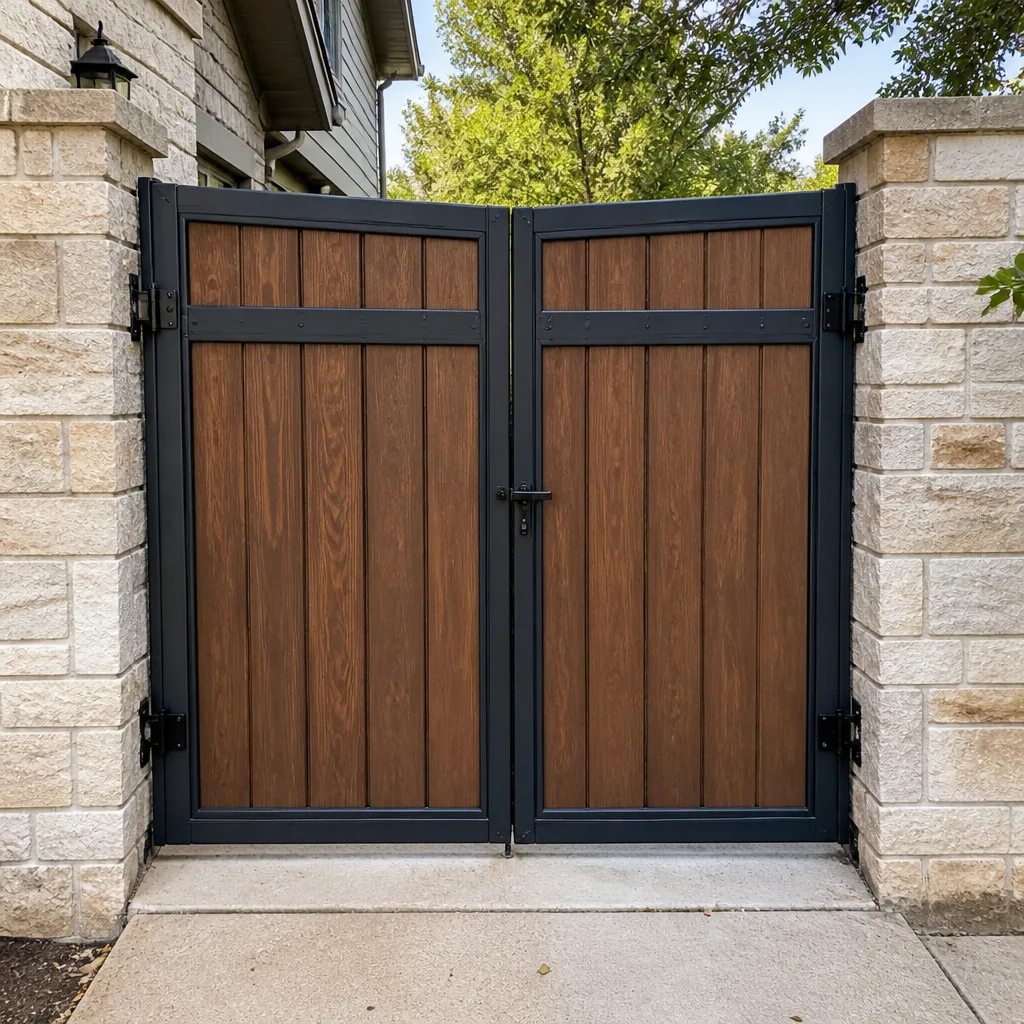 Wood & steel frame
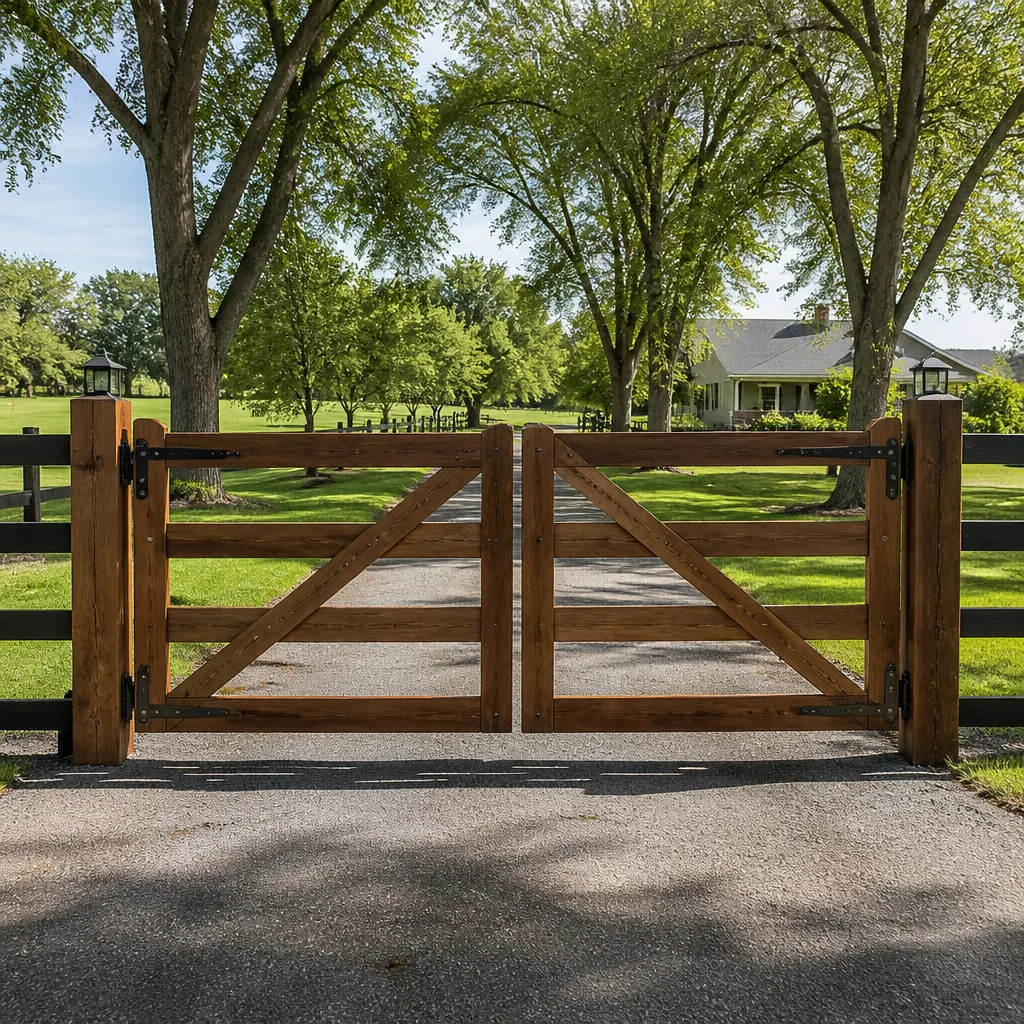 Farm & ranch
 Sliding driveway gates
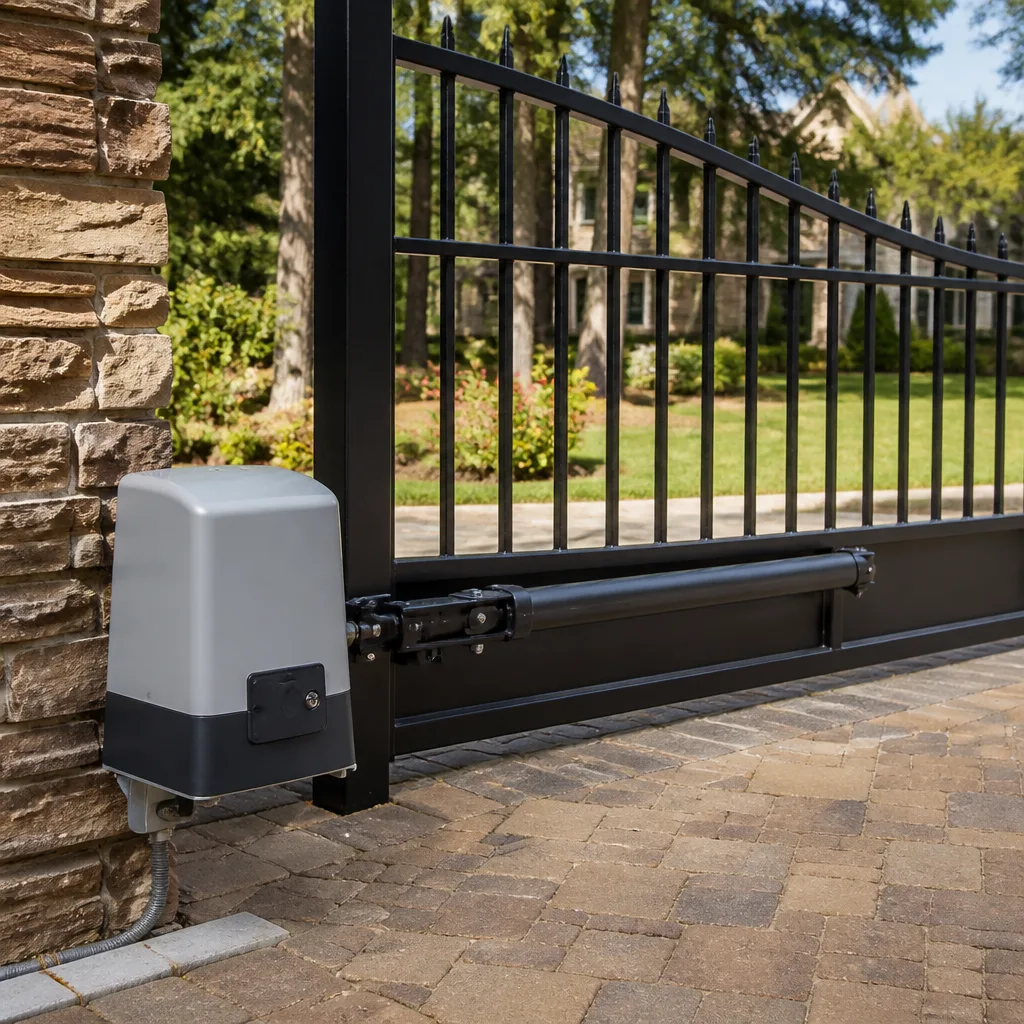 LiftMaster operators
Free on-site gate assessment - hinges, posts, and your LiftMaster or Nice gate operator checked before anything is quoted
The assessment is free and the quote is the invoice.
Get your free estimateGate Repair Maintenance Checklist for Summerlin Homeowners
Most gate maintenance checklists tell you to “lubricate the chain” and “check the sensors” – instructions so vague they’re useless to any homeowner who actually wants to catch a problem before it becomes a repair bill. What makes a checklist worth keeping isn’t the list of things to look at. It’s knowing what a passing measurement looks like. A chain that deflects 12mm under finger pressure is fine. The same chain at 22mm is three to six weeks from skipping a sprocket. This guide gives Summerlin homeowners real pass/fail thresholds for every major gate component, so you can walk out to your driveway with a tape measure and a notebook and speak to a technician in numbers instead of adjectives.
Quick Answer
A working residential gate in Summerlin should pass eight checks: chain deflection of 6-12mm at midpoint, limit switch gap set to the manufacturer spec (typically 2-4mm), hinge play under 1 degree, photo-eye offset under 0.5 inches, no grease thinning visible on the operator, no rust bloom at welds, gate level within 1/8 inch over its length, and manual release operating in under 10 seconds. Any reading outside those thresholds warrants a service visit before the next summer heat cycle. Check monthly in summer, quarterly the rest of the year.
Styles & brands we work with
- Wrought iron
- Wood & steel frame
- Farm & ranch
- Sliding driveway gates
- LiftMaster operators
Table of Contents
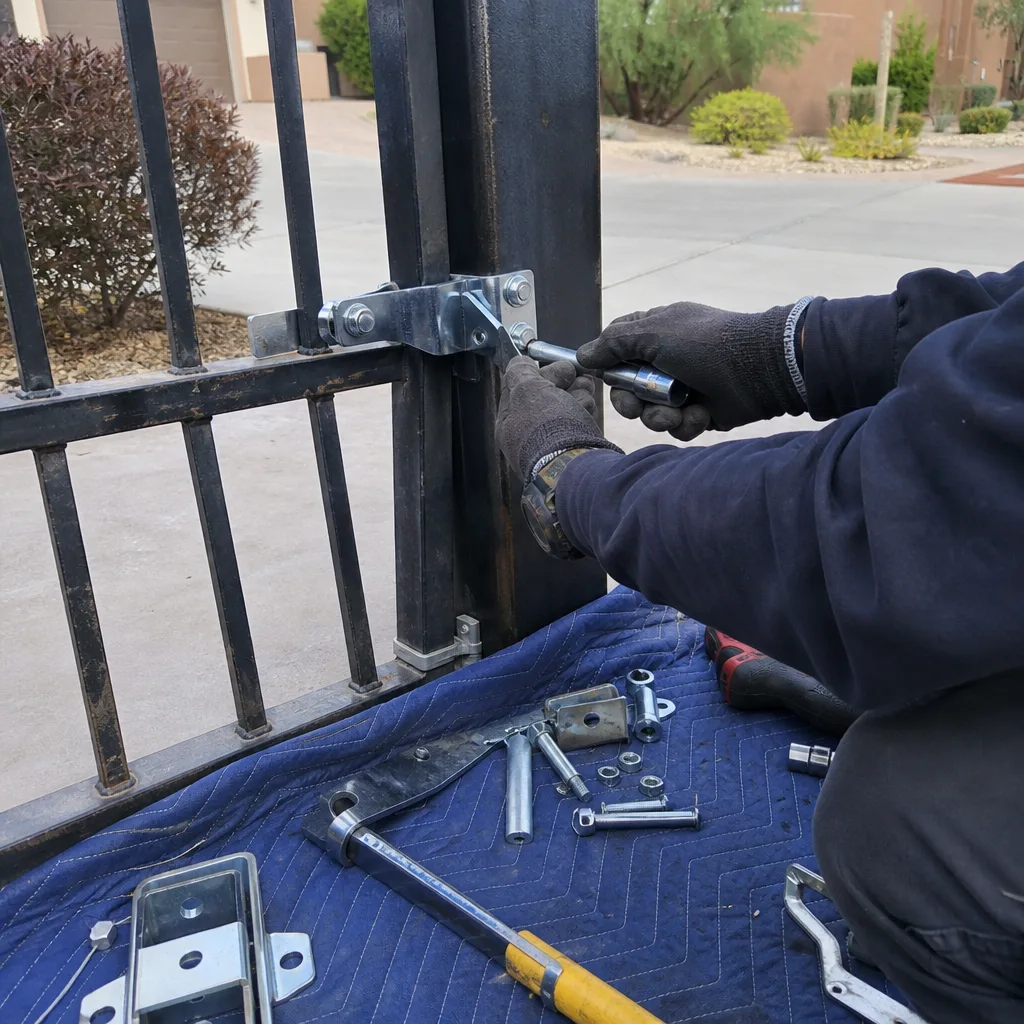
- Why Summerlin Gates Fail Differently Than National Checklists Assume
- The Eight-Point Monthly Checklist (With Pass/Fail Numbers)
- How 110°F Summers Destroy the Wrong Lubricant
- What’s DIY-Safe and What Isn’t
- The Log Format to Hand Any Technician
- Summerlin Service Intervals vs. National Averages
- Seasonal Shifts: Desert Wind, Monsoon Dust, Winter Cold Snaps
- Common Mistakes to Avoid
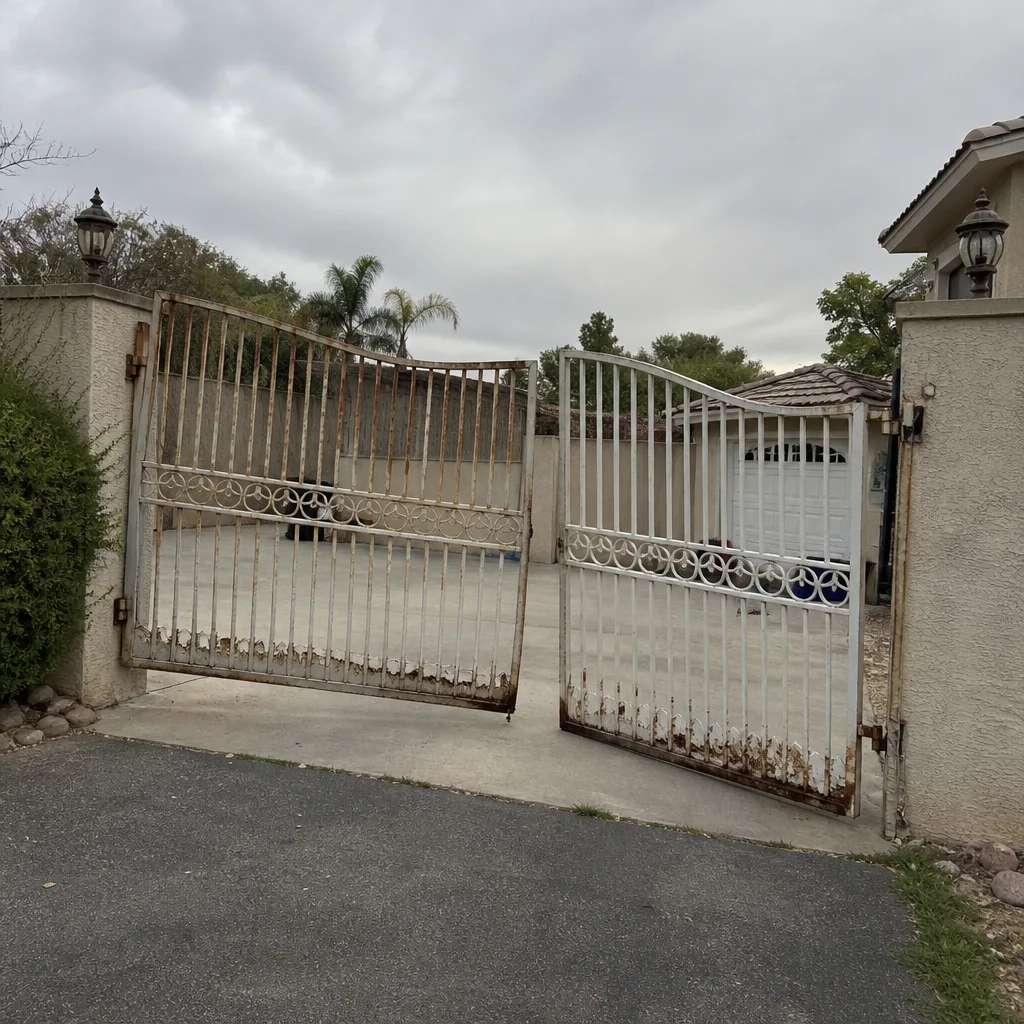 Before
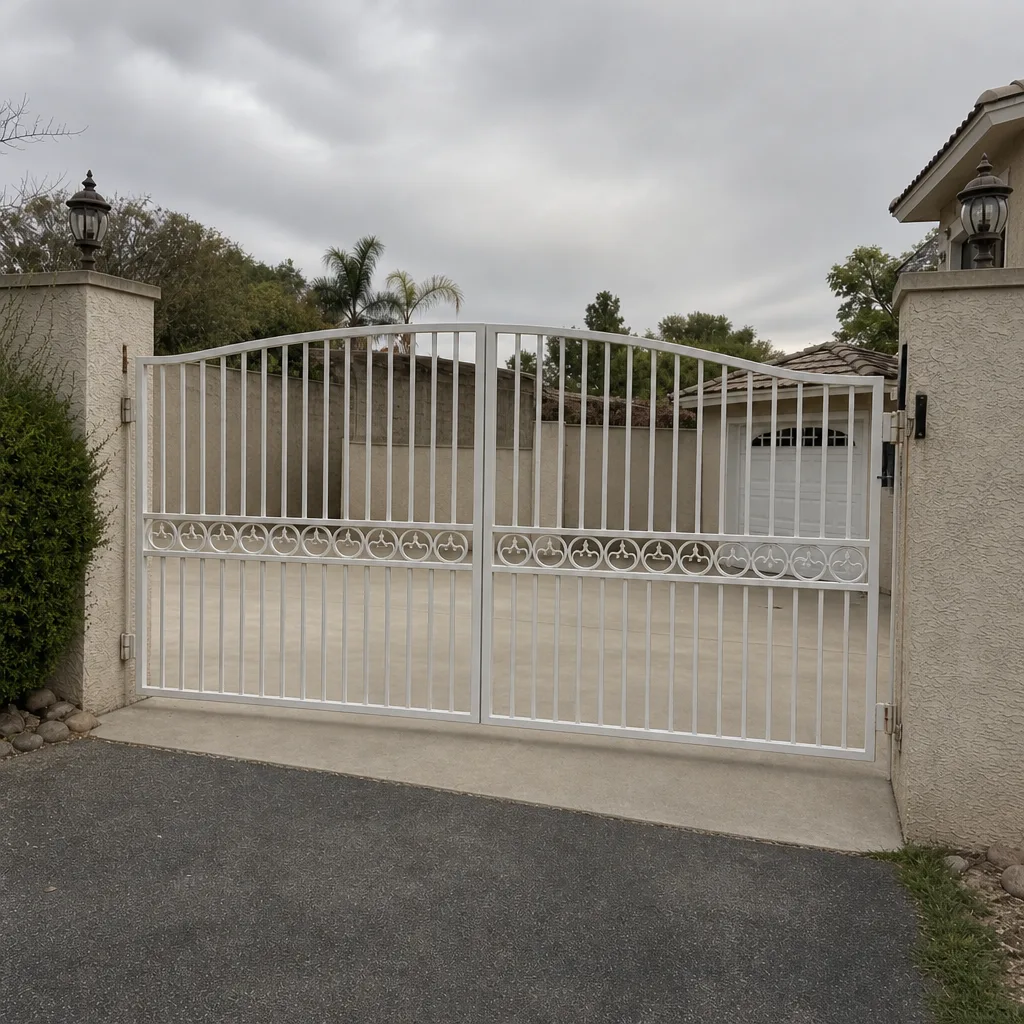 After
Why Summerlin Gates Fail Differently Than National Checklists Assume
Summerlin sits at roughly 3,000 feet in the Mojave, and the gate on your driveway lives a harder life than a gate in Portland or Charlotte. Three conditions are specific to the neighborhood and change what “normal wear” looks like:
- Peak summer heat. Operators on southern-exposure driveways in The Ridges and Red Rock Country Club regularly see surface temperatures above 140°F in July. Motors that are rated to 120°F ambient run at the edge of their tolerance for six to eight weeks a year.
- Wind-borne caliche dust. Spring and early-summer wind events off the Spring Mountains push fine alkaline dust into every exposed hinge, roller, and limit-switch housing. That dust is abrasive. It accelerates wear on linear actuators and photo-eye lenses faster than the national service manuals assume.
- Winter overnight cold snaps. January mornings in Summerlin can drop to the high 20s. Grease that was the right viscosity in August becomes wax in January, and the operator stalls on the first cold open. We see this most on gates facing north in Sun City Summerlin.
The practical result: a maintenance calendar built for a mild climate will let a Summerlin gate go 8 to 12 weeks past the point where it needed attention. The checklist below accounts for that. For a full picture of the repair options once a fault is confirmed, see our Gate Repair in Summerlin page.
The Eight-Point Monthly Checklist (With Pass/Fail Numbers)
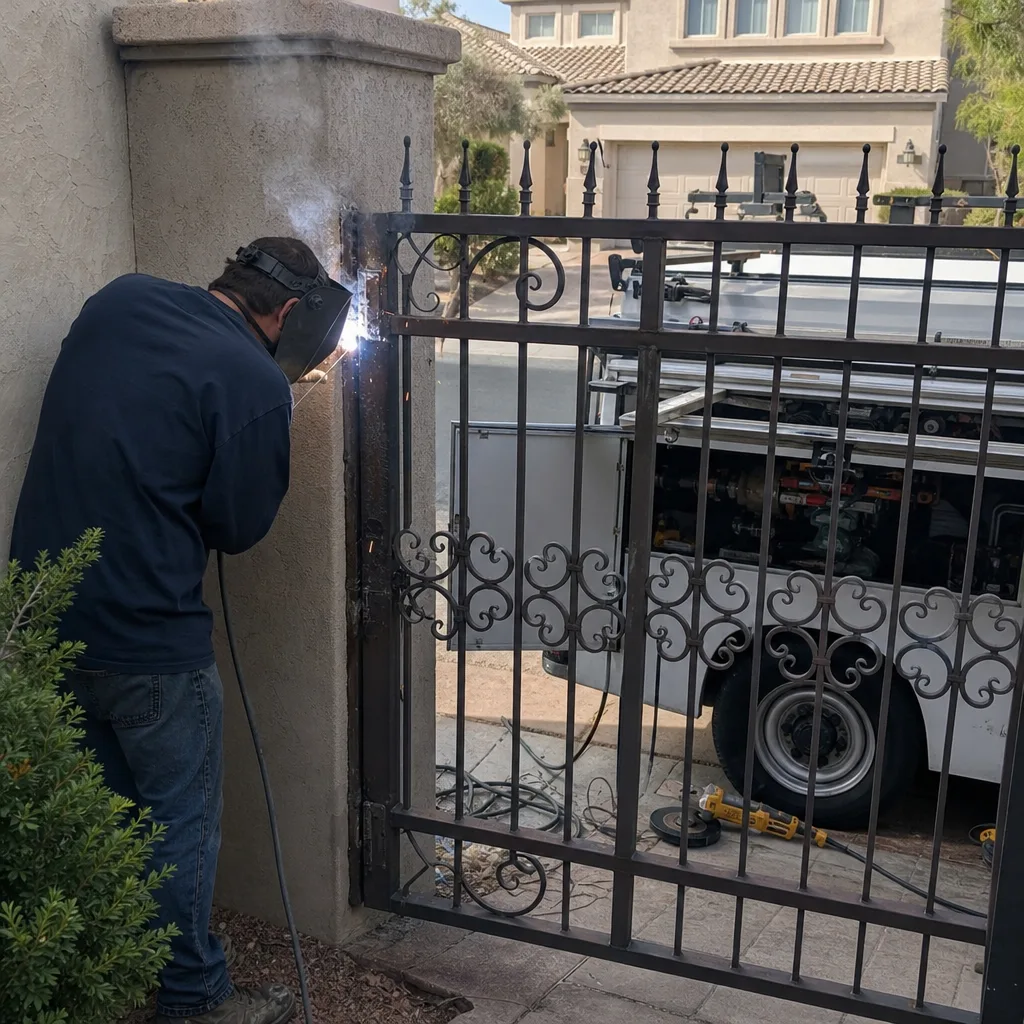
Do these eight checks once a month between May and September, and once every three months the rest of the year. Each one has a specific measurable threshold.
- Chain deflection (or belt tension). With the operator disengaged and the gate at mid-travel, press the chain down at midpoint. Pass: 6-12mm of deflection. Fail: under 4mm (over-tight, wears the sprocket) or over 15mm (will skip).
- Limit switch gap. Look at the limit-switch cam on the operator arm. The gap between cam and switch body should read 2-4mm on most FAAC and BFT residential arms. Fail: gap measured 5mm or more, or the gate over-travels 2+ inches past the stop point. This is a hard failure – a 12-degree over-travel on a Viking arm will eventually crack a hinge weld.
- Hinge play. Grab the gate at the hinge end and try to rock it. Pass: under 1 degree of play. Fail: visible movement at the hinge barrel or a clunk when you rock it.
- Photo-eye alignment. Stand at the photo-eye pair (the infrared beam that stops the gate if something crosses the path). Measure the vertical and horizontal offset between the two lenses. Pass: under 0.5 inches on both axes. Fail: 1 inch or more, or the receiving LED flickers when a car passes.
- Manual release function. Disengage with the key and move the gate by hand through its full swing. Pass: free movement, no binding, no scraping at any point. Fail: any point where the gate “sticks” – usually a worn roller or a hinge that needs grease.
- Gate level. Set a 4-foot level on the top rail. Pass: within 1/8 inch level over the length of the level. Fail: more, and you have a hinge or post-settlement problem – common on newer Summerlin builds where the caliche compacted asymmetrically.
- Weld and rust inspection. Look for rust bloom (a white to orange haze) at any weld joint. Pass: none. Fail: any bloom – it means water is pooling at that joint. Note the location.
- Operator housing temperature (mid-summer only). Touch the operator housing after a normal open cycle on a 105°F day. Pass: warm to the touch. Fail: too hot to hold your hand on for five seconds. That’s a motor on its way out.
Log every reading with date, time, and outside temperature. That log becomes the single most useful thing a technician can walk into.
How 110°F Summers Destroy the Wrong Lubricant
Petroleum-based grease is the reason most Summerlin operators fail early. Here’s the mechanism: standard petroleum grease is formulated for an operating range that tops out around 250°F for the base oil, but its dropping point – the temperature at which the soap thickener releases the oil – is often 180-200°F. On a south-facing operator housing in Summerlin, ambient surface temps hit 140°F by 11 a.m. in July, and the interior of the gearbox runs 20-30°F hotter. The grease separates. Base oil drips out, the thickener stays behind as a hard residue, and the gearbox runs dry for the rest of the summer.
We see this weekly in The Ridges and The Summit, where driveway gates face due south or southwest. The tell is a thin oil film under the operator housing and a stiff gate on the first open of the morning.
What to use instead:
- A lithium-complex or synthetic grease rated to 400°F dropping point or higher. Most FAAC and BFT operators specify this in their manual – follow the manual spec, not the hardware store shelf.
- For open chains, a dry-film PTFE lubricant rather than a wet oil. Dry film doesn’t collect dust the way wet lubricant does, which matters in a neighborhood with as much airborne dust as Summerlin.
- For hinges and rollers, a light synthetic grease every 90 days in summer, every 180 days in winter.
Reapply on the following schedule: open chains every 60 days May through September, every 120 days October through April. Hinges and rollers monthly in summer. Any linear actuator (the sliding-screw arm on a swinging gate) should never be greased on the screw itself unless the manual says so – grease on a linear screw attracts dust and accelerates wear.
What’s DIY-Safe and What Isn’t
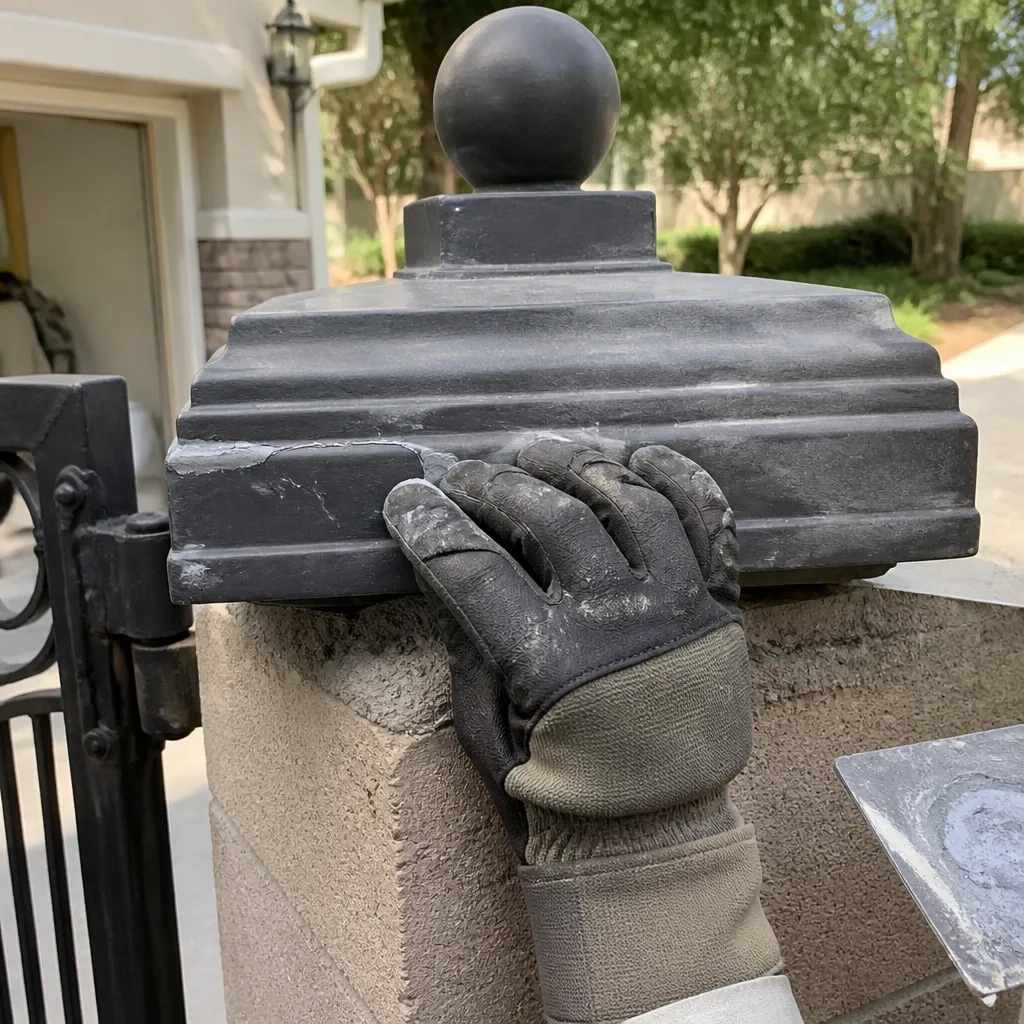
This is where most checklists get homeowners into trouble. Some of these checks are perfectly safe for anyone to do with a tape measure. Others involve line voltage or stored mechanical energy and belong to a trained technician.
DIY-safe (do these yourself)
- Chain deflection measurement with a tape measure
- Visual inspection for rust bloom and weld cracking
- Gate level check with a 4-foot level
- Hinge play check by hand
- Manual release function test
- Photo-eye offset check with a tape measure
- Wiping photo-eye lenses with a microfiber cloth
- Greasing exposed hinges and rollers per the manual spec
Call a technician (do not attempt)
- Any component on the line-voltage side. Inside the operator control box, the 120V input, the transformer, any capacitor, and the motor winding all carry lethal current even after the breaker is off, because capacitors hold a charge. This is not a repair for a homeowner.
- Spring tension adjustment. A torsion spring on a swing gate stores enough energy to break an arm. Never touch the spring, the spring anchor, or the cables that hold it. This applies to anyone who is not a trained gate technician.
- Limit switch adjustment on the operator cam – not the check, the adjustment. Diagnosis is DIY-safe; moving the cam to fix an over-travel is where a gate can run itself off the track and injure someone.
- Photo-eye electrical troubleshooting. If the lenses are aligned under 0.5 inches and the gate still reverses, the fault is in the wiring or the control board. That’s a call.
- Welding on any gate post or hinge. Structural welding on a gate that swings is a specialty job.
If you are not certain which side of that line a job falls on, the safe answer is always to schedule a visit. For operator-specific issues on Linear or FAAC arms, our Gate Motor & Opener in Summerlin page lays out the service options.
The Log Format to Hand Any Technician
The most valuable thing a homeowner can bring to a service call is a written record. Not because a technician can’t diagnose from scratch – they can – but because a service history eliminates the guesswork about when a fault first appeared, which is the difference between replacing a $40 part and replacing a $700 operator.
Use this format. A notebook works. A note on your phone works. A printed sheet on the refrigerator works best.
- Date and time. Include the day of week – weekend use patterns matter.
- Outside temperature and weather. “102°F, clear” reads differently than “78°F, monsoon dust.”
- Chain deflection reading in mm.
- Limit switch gap in mm (if you can see the cam).
- Photo-eye offset in inches.
- Hinge play: pass or fail.
- Manual release: seconds to disengage and free to move (y/n).
- Any noise or visual change. “Clunk on close at the 3/4 point” is a real, useful note.
- Operator housing heat: warm, hot, or too hot to hold.
- Any change since last reading. One sentence.
Three months of this log turns “it seemed slow” into “the chain deflected 19mm on July 12, and by August 3 it was 24mm – grease was separating and the sprocket was doing the work of pulling slack.” That’s a technician conversation you want to have. It’s also the kind of record that makes the 365-Day Done Right Promise on any completed repair faster to honor, because we can see exactly what changed and when. Our technicians bring their own documented photo record to every visit – under Clause 4 of The Haven Standard, every job includes photos of what was found, what was set, and what was replaced, no extra charge.
Summerlin Service Intervals vs. National Averages
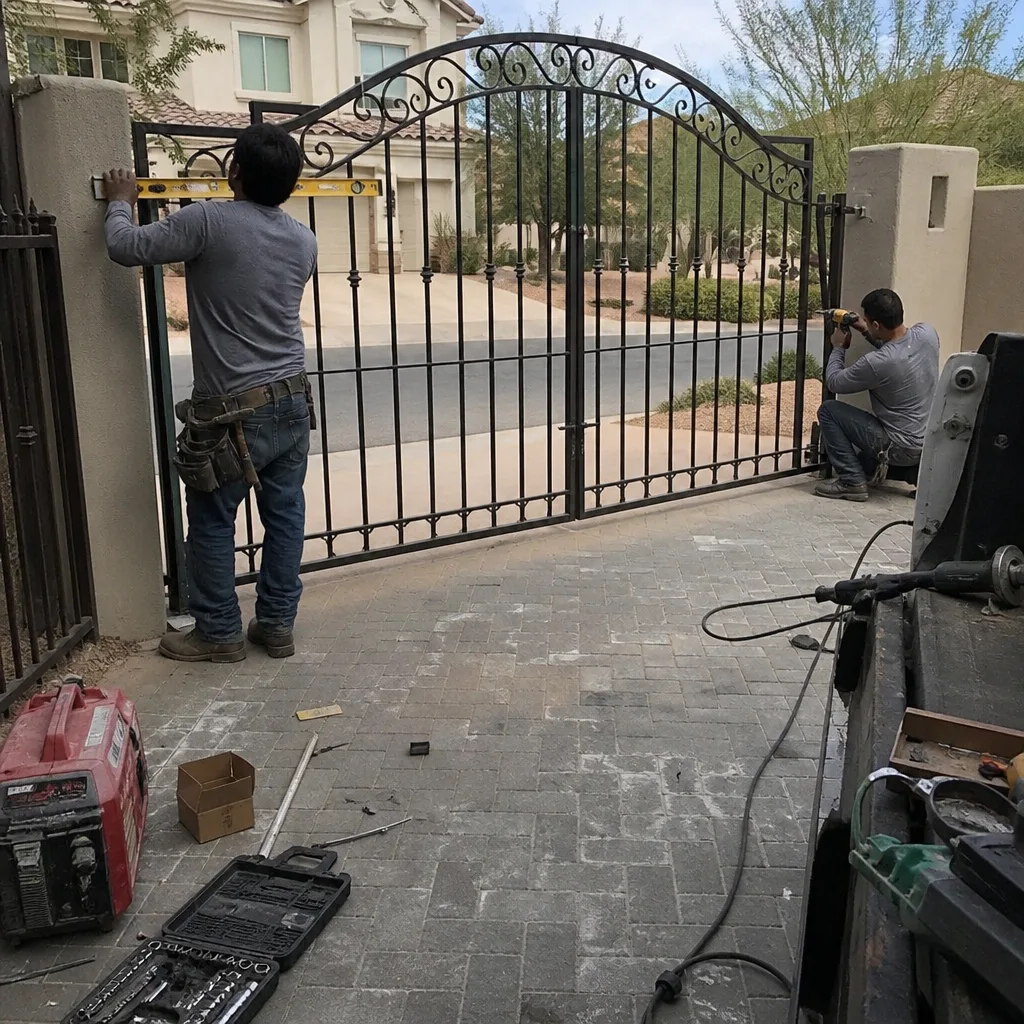
National gate maintenance calendars assume mild humidity, low ambient dust, and moderate temperature swings. Summerlin’s conditions shorten several of those intervals. Here’s the local picture:
- Chain lubrication: national 6 months. Summerlin 60 days May-September, 120 days October-April. Dust and heat together degrade lubricant faster than heat alone.
- Photo-eye lens cleaning: national 6 months. Summerlin 30-45 days. Fine caliche dust coats the lens and does not wash off in our low rainfall.
- Full professional inspection: national 12 months. Summerlin 6 months (spring and fall). The spring inspection catches winter cold-snap damage before summer heat compounds it; the fall inspection catches summer heat damage before winter.
- Hinge and roller grease: national 12 months. Summerlin 90 days.
- Manual release test: national once a year. Summerlin monthly – it is the fastest way to spot a binding roller before it fails.
If your gate faces full south or west exposure (common on Summerlin lots that back to open desert or a wash), shorten every interval by 30%. We’ve seen south-facing FAAC arms in Summerlin need chain service every 45 days in peak summer, not 60.
Seasonal Shifts: Desert Wind, Monsoon Dust, Winter Cold Snaps
A checklist that doesn’t change with the season misses half the failures. Summerlin’s calendar has three distinct gate-stress periods:
Spring (March to May): wind and dust
The Spring Mountains funnel wind through the west valley in March and April, and it carries fine grit that finds every open bearing. Post-wind-event, do the eight-point check within 48 hours. This is when photo-eye misalignments show up – the wind nudges the post a fraction of an inch, and suddenly the beam is offset by an inch and a half.
Summer (June to September): heat
July and August are the operator test. If your grease is the wrong spec, this is when it fails. Watch for the operator stopping mid-cycle on the hottest part of the day, tripping the thermal overload. That’s a sign, not a nuisance. If the operator stalls, don’t keep hitting the remote – each retry strains the motor.
Late Fall / Winter (November to February): cold-snap binding
Overnight temperatures in the high 20s are enough to stiffen grease that was fine in August and make a borderline-tight chain fail on the first cold morning open. Test your manual release monthly through this window. If the gate binds in the cold and frees up in the afternoon, you have a lubricant viscosity problem, not a gate weight problem.
For homeowner concerns spanning both new-gate work and repair, see the Vance Gate Repair Summerlin home page and our Gate Installation in Summerlin resource, which cover how seasonal behavior differs between new installs and existing gates.
Common Mistakes to Avoid
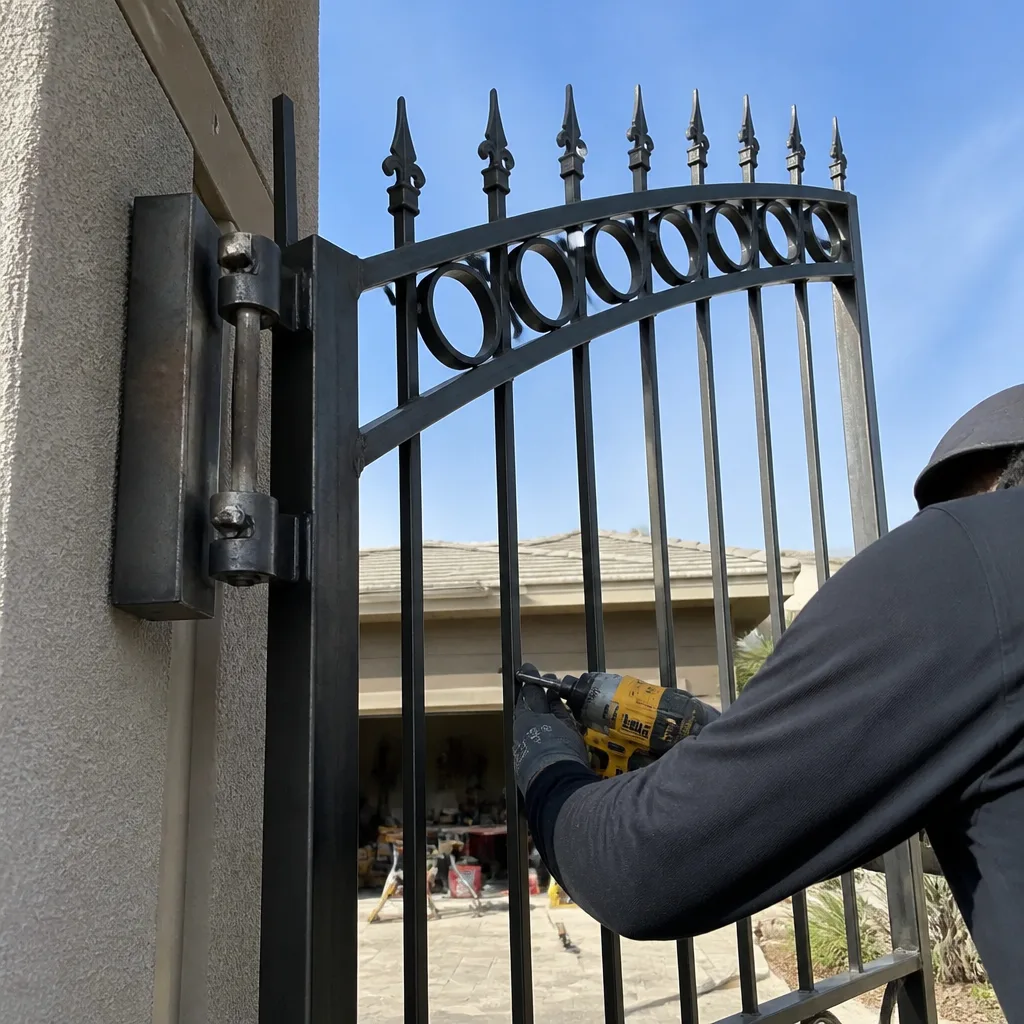
- Using general-purpose grease from a hardware store. The $7 tube from the shelf is petroleum-based with a low dropping point. In a Summerlin summer, it separates in the gearbox after 4-6 weeks. Use the spec in your operator manual – FAAC, BFT, Linear, and Viking all publish it.
- Over-tightening the chain to fix a “loose” feeling. A chain deflecting under 4mm will wear the sprocket faster than a slack chain will. Fix the sprocket, not the slack.
- Cleaning photo-eye lenses with a paper towel. Paper towels scratch the polycarbonate lens and scatter the beam. Microfiber only, dry.
- Ignoring a clunk for a season. A clunk on a Summerlin gate in August usually means a hinge weld is stressed. Left alone, it becomes a $400 weld-and-hinge job by spring instead of a $75 grease-and-adjust job now.
- Testing the safety reverse by driving into the gate. This strains the operator and stress-tests the hinge welds. Walk through the beam instead – it does the same job without the wear.
- Skipping the log. The single biggest reason repairs get more expensive on a second visit is the missing service history. Without it, every trip is a discovery trip.
- Assuming the national 12-month inspection interval applies here. In Summerlin, 12 months means you’ll miss at least one seasonal stress period before you catch the resulting fault.
See the difference
BeforeAfter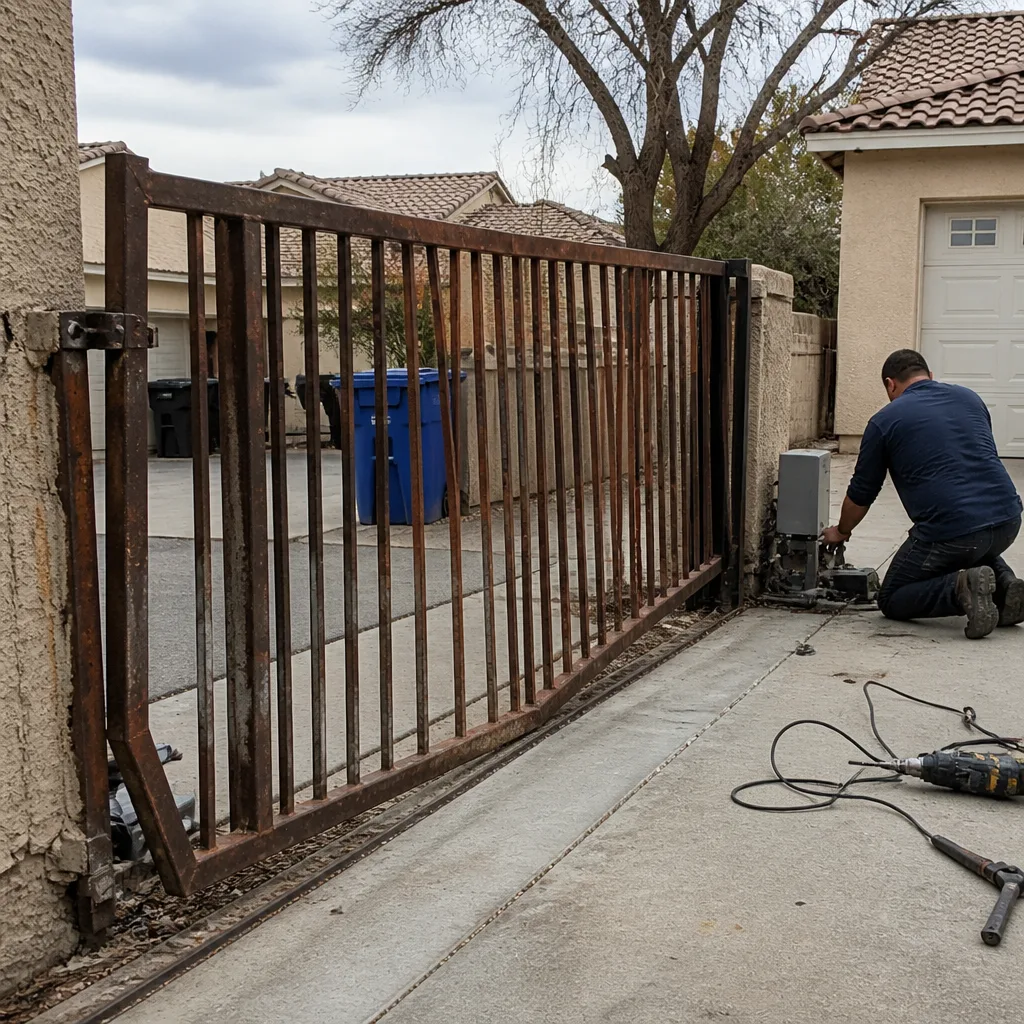 Before
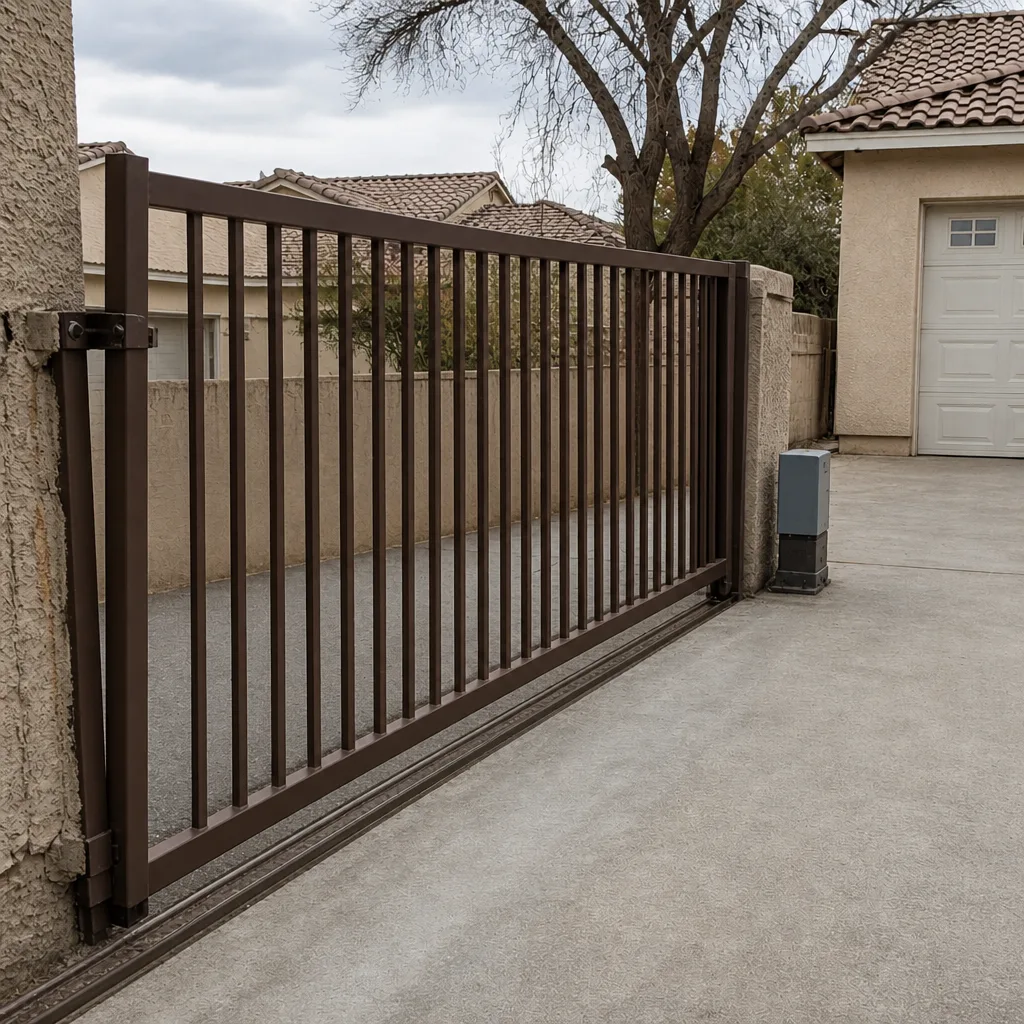 After
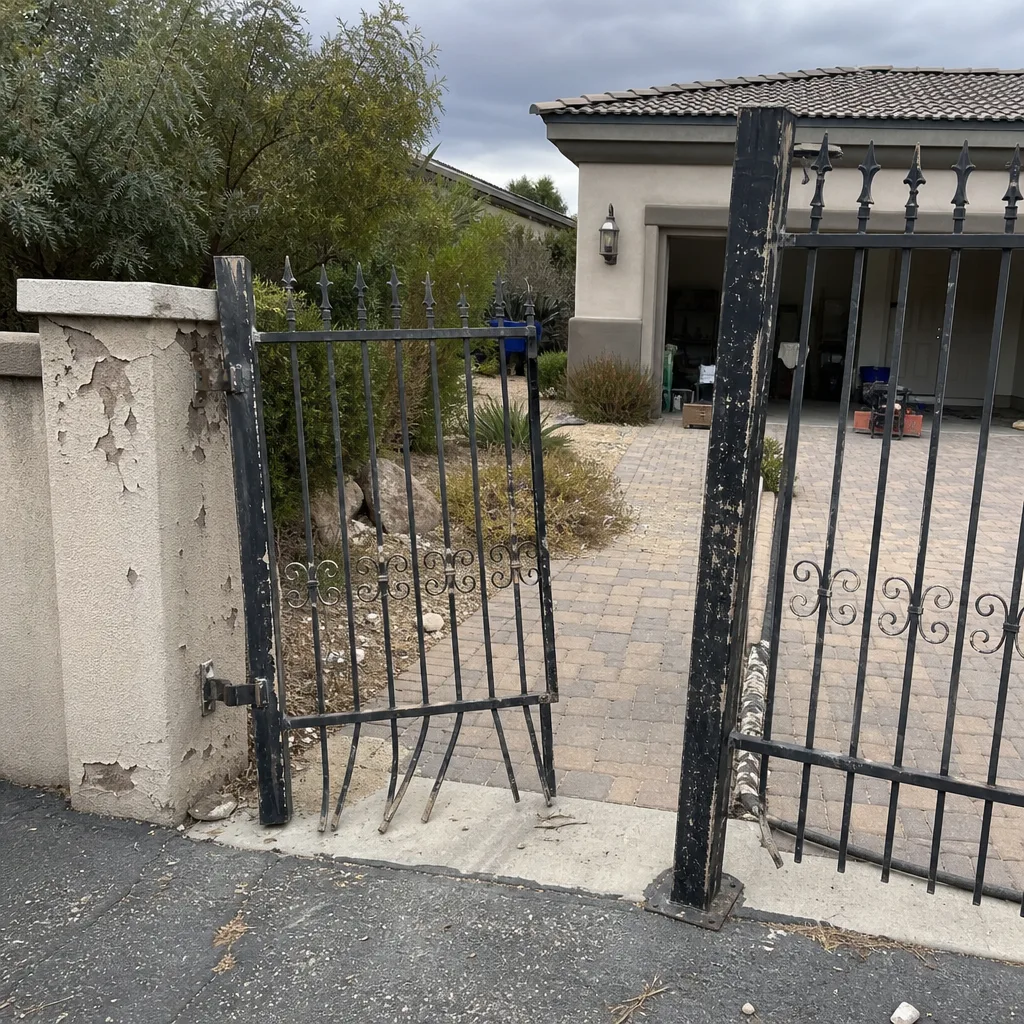 Before
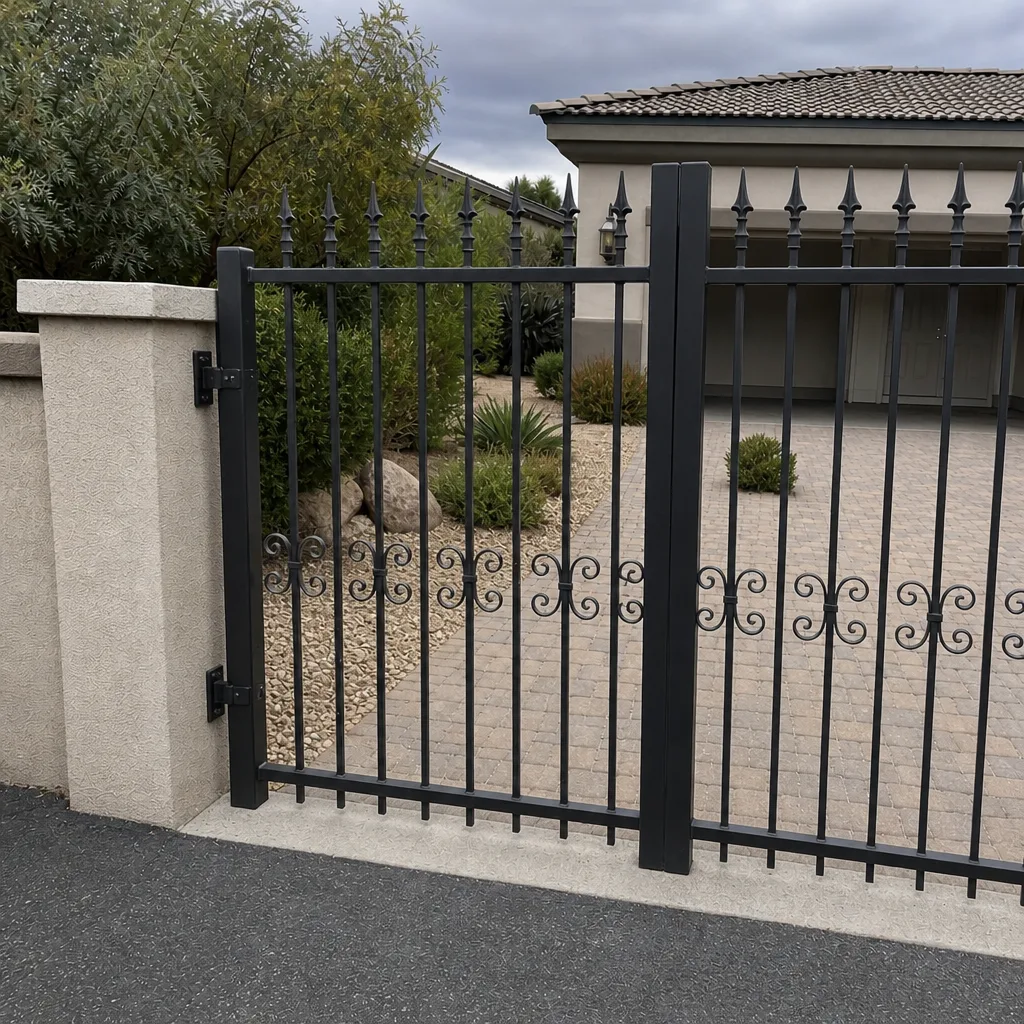 After
When to Call a Professional
Call a professional the moment any of these appear:
- Any line-voltage fault – the operator won’t close, won’t open, or trips the breaker.
- Gate over-travels 2 inches or more past the stop point, or refuses to fully close.
- Visible rust bloom at a weld joint or a crack in a hinge barrel.
- A torsion spring makes noise, looks rusty, or the gate suddenly feels heavier.
- Manual release binds at any point in the swing.
- Photo-eye aligned within 0.5 inches and the gate still reverses.
- Operator housing too hot to hold for five seconds after a normal cycle.
Vance Gate Repair Summerlin offers free written estimates in Summerlin – call (844) 797-2809. We’ll bring a tape measure, log our own readings to compare against yours, and hand you a written price before any tool comes out, under Clause 1 of The Haven Standard. Our technicians have up to 12 years of experience and work on nine residential and light-commercial automation brands, so we can service whatever motor is already on your gate instead of steering you toward a replacement. If you’ve had another company quote, we’ll give you a free second opinion on their written estimate – bring the paperwork.
Frequently Asked Questions
Check the eight-point list once a month from May through September and once every three months the rest of the year. Summerlin’s heat, wind-borne dust, and winter cold snaps each stress different components at different times – monthly checks in summer catch a problem before it becomes a repair bill, quarterly checks in the cooler months keep an eye on lubricant viscosity changes.
A properly tensioned residential gate chain should deflect 6-12 millimeters when you press it at midpoint with the operator disengaged. Under 4mm means the chain is over-tight and wearing the sprocket; over 15mm means it’s slack enough to skip under load. Measure with a tape measure against the gate frame and log the reading – call (844) 797-2809 for a service visit if you measure outside that range.
Greasing exposed hinges and rollers is safe and we encourage it, following the manual’s spec for grease type and frequency. Anything on the line-voltage side of the operator – the control box interior, the capacitor, the transformer – is not safe for a homeowner because capacitors hold a charge even after the breaker is off. Torsion springs and cables are also off-limits; they store enough energy to injure. When in doubt, call (844) 797-2809 for a free estimate rather than risk it.
Thermal overload – the motor’s built-in protection is cutting out before the winding overheats. On a south-facing operator in Summerlin, ambient housing temperatures can hit 140°F in July, and petroleum-based grease has often separated well before that, so the gearbox is running dry. Don’t keep hitting the remote; each retry strains the motor. Call (844) 797-2809 and we’ll diagnose whether it’s a lubricant issue, a capacitor fading under heat, or a motor at end of life.
Log date, time, outside temperature and weather, chain deflection in mm, limit switch gap in mm, photo-eye offset in inches, hinge play pass/fail, manual release function, operator housing heat (warm/hot/too hot), and any noise or visual change since the last reading. Even one sentence per entry is enough – three months of readings turns “it seemed slow” into “the chain deflected 19mm on July 12 and 24mm by August 3,” which changes the diagnosis and often the repair cost. Call (844) 797-2809 to schedule a visit and we’ll compare our readings against yours.
Yes, and it’s more common in Summerlin than in milder climates because wind events nudge gate posts a fraction of an inch, which translates to a larger offset at the photo-eye pair. A half-inch shift at the post can put the lenses 1.5 inches out of alignment, and the gate starts reversing on nothing. Check the vertical and horizontal offset with a tape measure monthly – anything over 0.5 inches needs attention. Call (844) 797-2809 if re-alignment doesn’t hold after a wind event – it usually means the post needs re-seating.
The Bottom Line
A maintenance checklist earns its keep only when it tells you what “pass” looks like in millimeters and inches, not when it tells you to “check the sensors.” The eight checks above – chain deflection 6-12mm, limit switch gap 2-4mm, hinge play under 1 degree, photo-eye offset under 0.5 inches, manual release free through the full swing, gate level within 1/8 inch, no rust bloom at welds, operator housing warm not hot – give Summerlin homeowners real thresholds. Run them monthly in summer, quarterly in winter, and log the readings with date and temperature. That log is the single most valuable thing you can hand a technician, and it’s the reason a $75 adjust stays a $75 adjust instead of becoming a $400 repair.
If any reading is outside the pass range or you’d rather a trained eye confirm the diagnosis, call Vance Gate Repair Summerlin at (844) 797-2809 for a free written estimate. We’ll measure, photograph, and document what we find – and you’ll have the price in writing before any work begins.
Written by the team at Vance Gate Repair Summerlin.