
Last updated November 17, 2026
 Wrought iron
 Wood & steel frame
 Farm & ranch
 Sliding driveway gates
 LiftMaster operators
Free on-site gate assessment - hinges, posts, and your LiftMaster or Nice gate operator checked before anything is quoted
The assessment is free and the quote is the invoice.
Get your free estimateDIY vs Professional Gate Parts & Welding: What’s Safe to Do Yourself
Most gate repairs that look finished are finished. Some aren’t, and the ones that aren’t don’t announce themselves. A hinge re-bolted with the wrong hardware can hold a gate leaf for weeks before the post starts to lean. A weld that “took” can pass a wiggle test and fail under wind load six months later. We’ve pulled enough failed homeowner welds off Summerlin gate frames to know the difference isn’t confidence or even skill. It’s documentation. This guide sorts gate work into three tiers: what you can safely do yourself, what carries real risk, and what only a trained welder or gate technician should touch.
Quick Answer
Lubrication, tightening loose hardware, cleaning tracks, and treating light surface rust are safe for most homeowners to handle with basic tools. Structural welding on gate frames, post anchor work, and anything involving the gate’s load-bearing geometry are not – a bad weld on a hanging gate is a liability, especially in an HOA community, and it fails in ways you cannot see by looking. If a repair involves cutting, welding, or re-anchoring, call a professional.
Styles & brands we work with
- Wrought iron
- Wood & steel frame
- Farm & ranch
- Sliding driveway gates
- LiftMaster operators
Table of Contents
- The Three Tiers of Gate Work
- What’s Actually Safe to Do Yourself
- Why Amateur Welding on Gate Frames Is a Specific Risk
- HOA Liability and What It Means for You
- The Tool and Knowledge Gap
- The Documentation Problem With DIY Structural Work
- How to Describe What You Observed When You Call
- Common Mistakes to Avoid
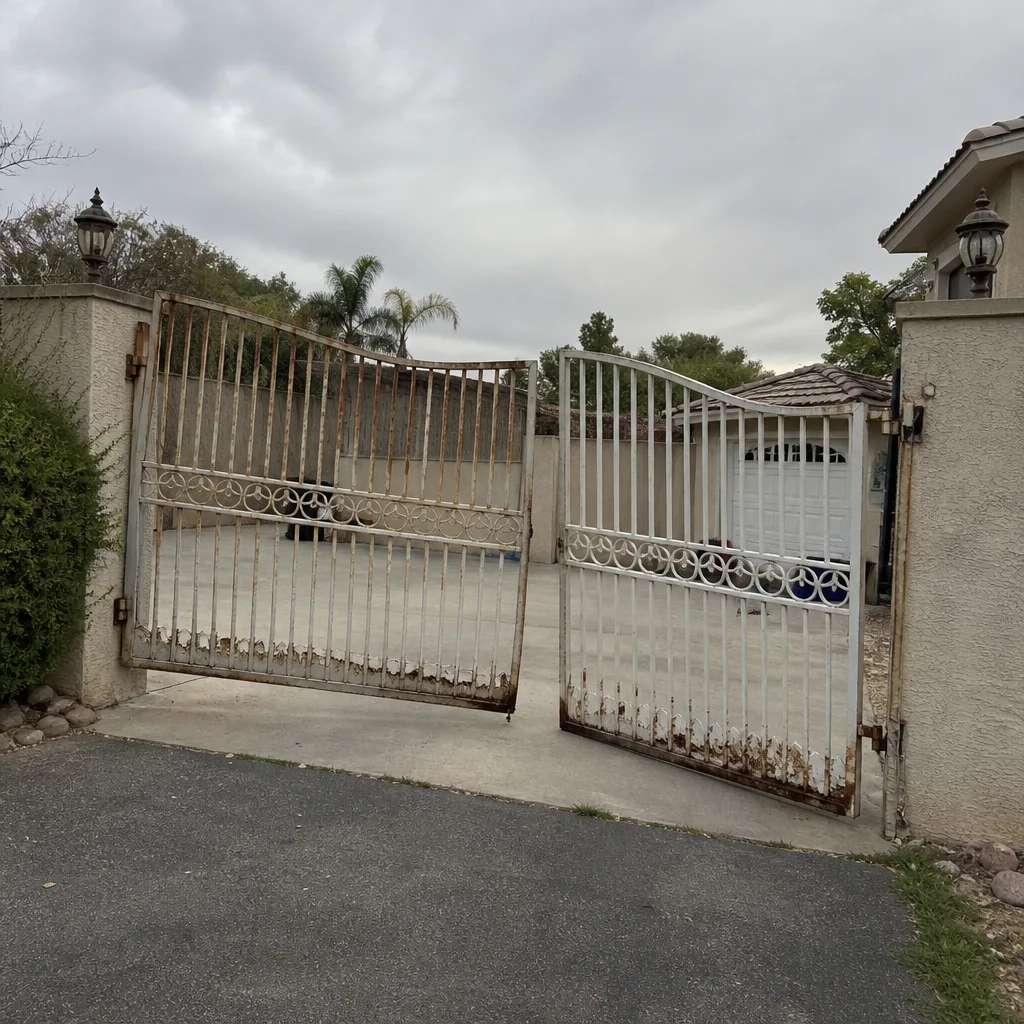 Before
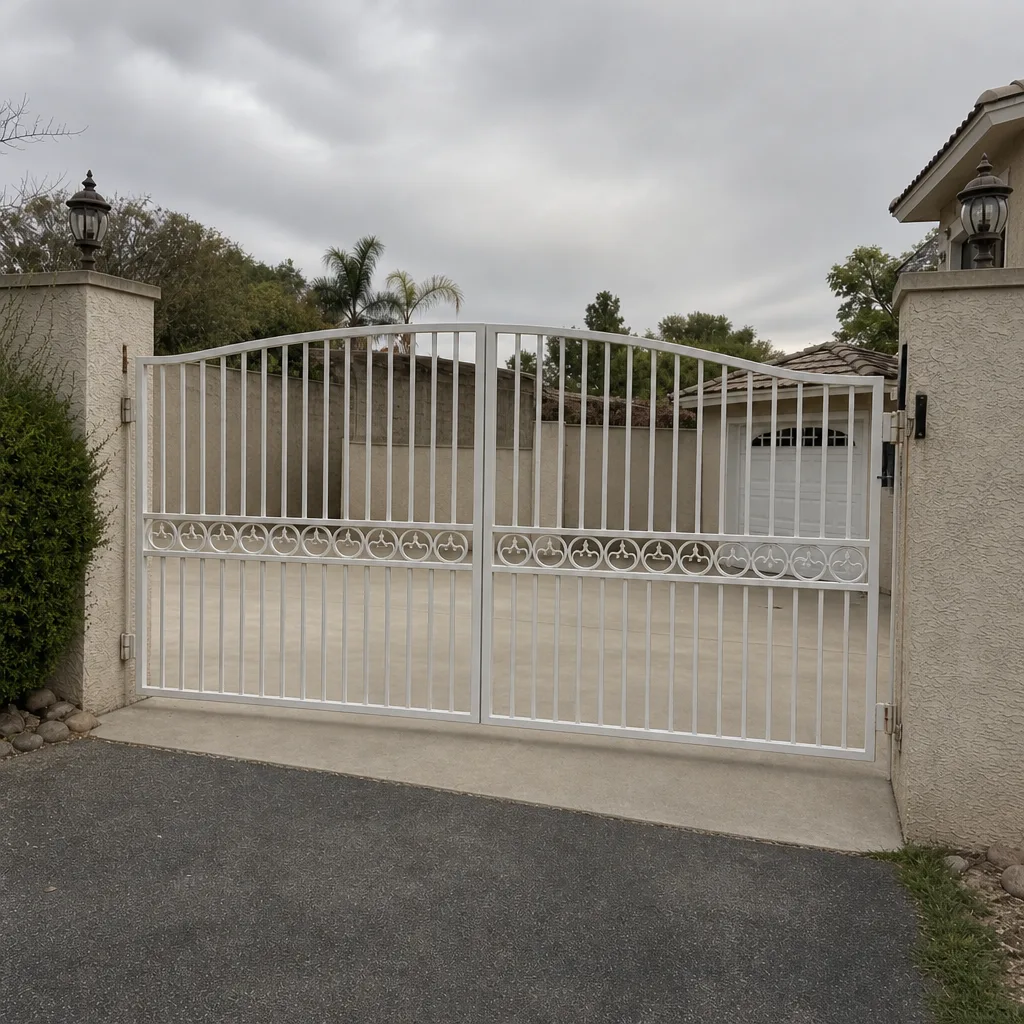 After
The Three Tiers of Gate Work
Not every gate task belongs in the same category. Sorting the job before you pick up a wrench is the single most useful thing you can do. Here’s how we break it down when a Summerlin homeowner calls and asks whether they should attempt a fix themselves.
Tier 1: Safe for most homeowners
- Lubricating hinges, latches, and rollers with a proper gate-rated lubricant
- Tightening bolts and screws that have worked loose from vibration
- Cleaning debris from roller tracks and the gate’s travel path
- Wiping down and spot-treating light surface rust before it pits
- Replacing a worn rubber stop or a plastic roller wheel on a sliding gate
Tier 2: Possible with caution, but know the limits
- Replacing a hinge pin (only if the existing weld and post are sound)
- Adjusting a photo-eye or safety edge after a documented reset
- Replacing a keypad or standalone access-control keypad on a low-voltage circuit
- Painting over prepared metal after rust treatment has fully cured
Tier 3: Not safe for homeowners
- Any welding on the gate frame, hinge plates, or post connections
- Re-anchoring or resetting a post that has shifted in the ground
- Cutting or modifying frame members to change gate geometry
- Working on the high-voltage side of a gate operator
- Repairing a torsion spring, counterweight, or any component under stored load
Notice where the line falls. Tier 1 is maintenance. Tier 2 is small parts on a sound structure. Tier 3 is structural – and structural work is where the consequences live. Our technicians have up to 12 years of experience, and the first thing any of them will tell you is that a gate is a loaded mechanical system, not a fence panel.
What’s Actually Safe to Do Yourself
Maintenance is where a homeowner genuinely saves money and reduces future repair costs. Summerlin’s dry climate is hard on gate hardware – low humidity preserves metal longer than in coastal cities, but the intense UV and the dust that blows through open desert lots work grit into hinges and tracks faster than most people expect. A little upkeep goes a long way.
- Lubricate every hinge and moving part, twice a year. Use a lubricant rated for exterior gate hardware, not cooking spray or general-purpose oil. Apply, cycle the gate open and closed a few times, then wipe off the excess so it doesn’t collect dust.
- Tighten loose hardware, and check it again in two weeks. Vibration loosens bolts on swinging gates more than people realize. Snug, don’t over-torque – stripped threads in an aluminum hinge plate create a bigger problem than the one you started with.
- Clear the travel path and clean the track. On a sliding gate, grit in the track accelerates roller wear and can throw the gate off alignment. Sweep and wipe, don’t pressure-wash near the operator housing.
- Treat surface rust promptly. Light, powdery rust on paint is cosmetic. Sand it back to clean metal, treat with a rust converter, prime, and paint. Rust that has pitted or spread at a weld seam is a different problem and belongs in Tier 3.
- Observe and photograph. This is the one most homeowners skip. Take a photo of what you see before you touch anything. If the issue turns out to be bigger than expected, that photo is the starting record.
One caveat on surface rust: if the rust is concentrated at a hinge weld, a post base plate, or anywhere a structural member meets another, treat it as a symptom, not a cosmetic issue. That’s where moisture has been sitting and the metal underneath may be thinner than it looks. For a routine maintenance check or a repair that’s gone past the Tier 1 line, gate repair in Summerlin is where we start homeowners who want a documented assessment before deciding.
Why Amateur Welding on Gate Frames Is a Specific Risk
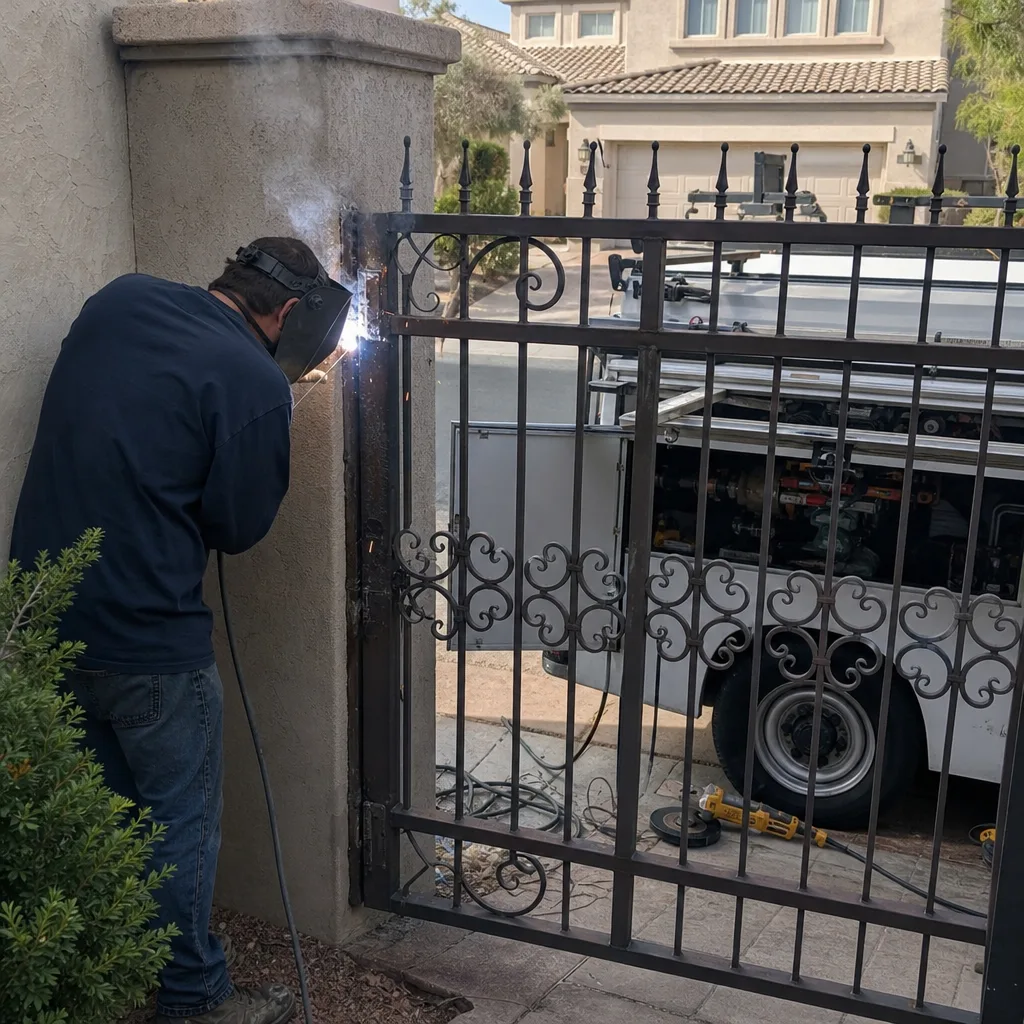
This is the part of the conversation we have most often, and it’s the part most DIY guides skip. Welding a gate frame isn’t like welding a decorative garden chair. The gate is a loaded structure: it hangs from hinges that transfer the full weight of the leaf into a post, and every swing or slide puts cyclic stress on those connections. A weld that looks solid can be a cosmetic bead with almost no penetration into the parent metal.
The gap between a cosmetic weld and a structural one comes down to a few specific things:
- Penetration: Structural welds need fusion into the base metal, not just a bead sitting on the surface. On thin-walled gate tubing, this is genuinely difficult to achieve without blowing through the metal. Too hot and you burn a hole; too cold and you get a weld that fails under load.
- Rod type: Mild steel gate frames need a matching electrode and the right amperage for the wall thickness. The wrong rod on the wrong metal produces a brittle joint that cracks instead of flexing.
- Post anchor work: Welding a hinge back onto a post is one thing. Re-anchoring a post that’s shifted in the ground – or welding new plates onto a post whose concrete footing is compromised – is a structural repair that needs the load path understood before anyone strikes an arc.
- Heat distortion: Gate frames warp under uneven heat. A frame that was square can come out of a weld twisted by a few degrees, which throws off the operator’s limit positions and can crack the frame at the next stress point.
There’s also a safety edge worth naming plainly: welding produces sparks, hot slag, and UV that can ignite dry vegetation or damage nearby surfaces, and working around a powered gate operator introduces electrical risk on top of it. If the gate has an operator from Viking, Elite, or any other brand on the frame, the power comes off before any metal work begins. That’s not a homeowner step-by-step; it’s the reason a trained welder is involved at all. When the fix is on the motor or control side rather than the frame, we handle it under our gate motor & opener service in Summerlin.
HOA Liability and What It Means for You
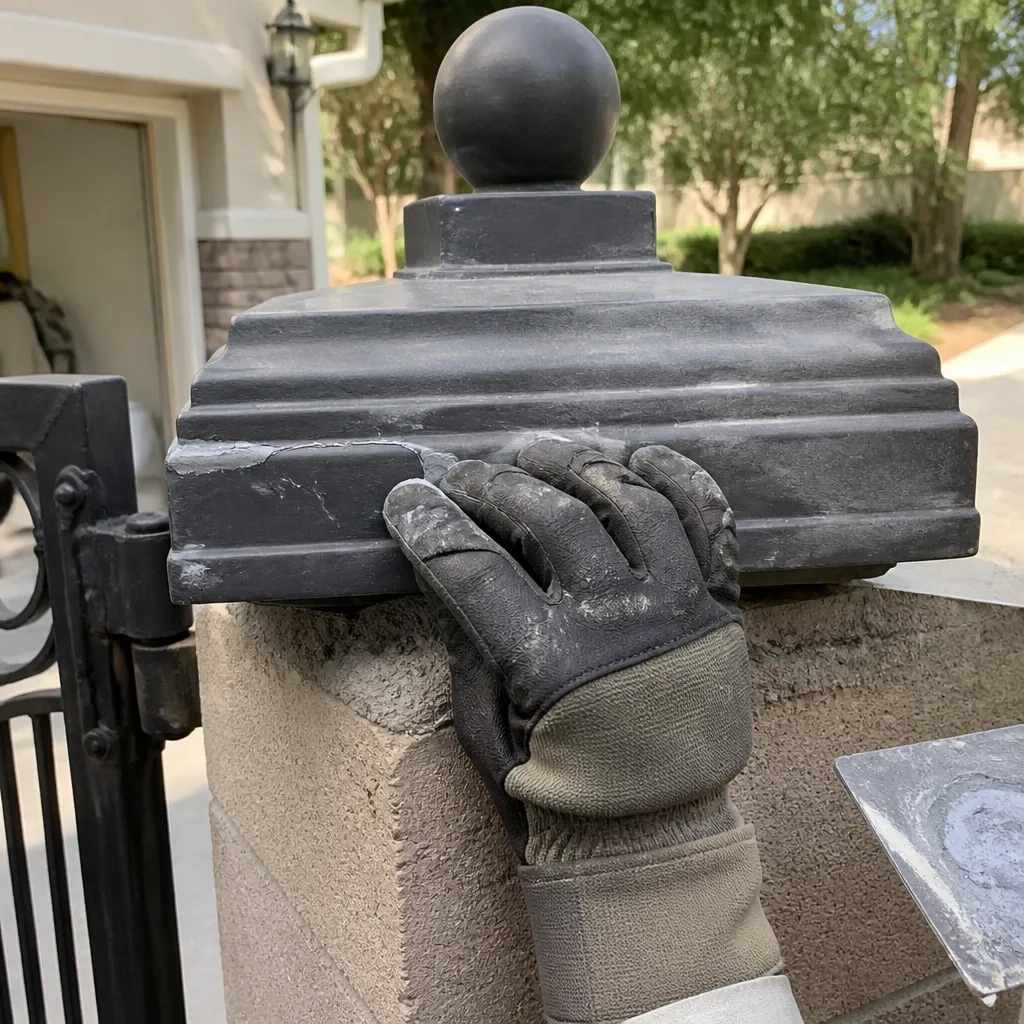
This is where Summerlin gate repairs diverge from repairs in a lot of other places. Many Summerlin communities are governed by HOAs with architectural review requirements, and gates facing the street are often treated as part of the community’s visual standard. That has two practical consequences for a homeowner considering a DIY weld or structural repair.
The first is documentation. When an HOA architectural committee reviews a repair – or an insurance claim follows a gate failure – the record of who did the work and how it was done matters. An undocumented DIY structural repair leaves you with no load test, no photo record, and no written scope. If the gate later fails and causes damage or injury, you’re the one explaining the repair with nothing to show.
The second is liability. A gate is a heavy object that cycles hundreds of times a month. A failed weld on a gate leaf can drop that leaf, and a failed post anchor can send the whole gate off its hinges. In a shared-wall or shared-driveway community, that failure can damage a neighbor’s vehicle, block an access point, or injure someone at the property line. Most homeowner policies will look closely at unpermitted, undocumented structural work when a claim comes in. We’re not your insurance advisor – but the pattern is consistent enough that it’s worth saying plainly: an amateur weld on a gate frame in an HOA community is a documented liability waiting for an event.
For a community where gates need to keep working and records need to be clean, the value of a written scope and a photo log isn’t convenience. It’s the thing that keeps a repair on the right side of the paper trail.
The Tool and Knowledge Gap
People underestimate how much of professional gate repair is tooling, not talent. A homeowner with a hobby welder and good intentions is often missing most of the equipment that makes a structural repair reliable. Here’s the honest gap.
- A welder rated for the metal: Gate frames are typically thin-wall steel or aluminum. Aluminum needs a different process entirely (spool gun or TIG), and most hobby MIG setups won’t do it well.
- Penetration and heat control: Setting amperage to match wall thickness takes repetition. On thin tube, the margin between a good weld and a burn-through is small.
- Post anchor knowledge: Hinge plates, base plates, and anchor bolts all have specific load requirements. Setting them correctly means understanding concrete, expansion anchors, and the gate’s swing geometry.
- Alignment and geometry: Re-welding a hinge in the wrong position throws off the gate’s plumb, its latch alignment, and the operator’s limit-switch travel. A gate that isn’t square will fight every component attached to it.
- Load testing: After a structural repair, a gate should be cycled under load and checked for deflection. A hobbyist has no way to do this reliably, and no record that it was done.
None of this means a homeowner can’t weld. Plenty can. The difference is that a professional gate technician does this on gates every week and brings the tooling, the metal knowledge, and the documentation habit together. On the hardware side of the same problem, our gate installation in Summerlin team handles new gates and frames built to hold up under exactly this kind of stress.
The Documentation Problem With DIY Structural Work
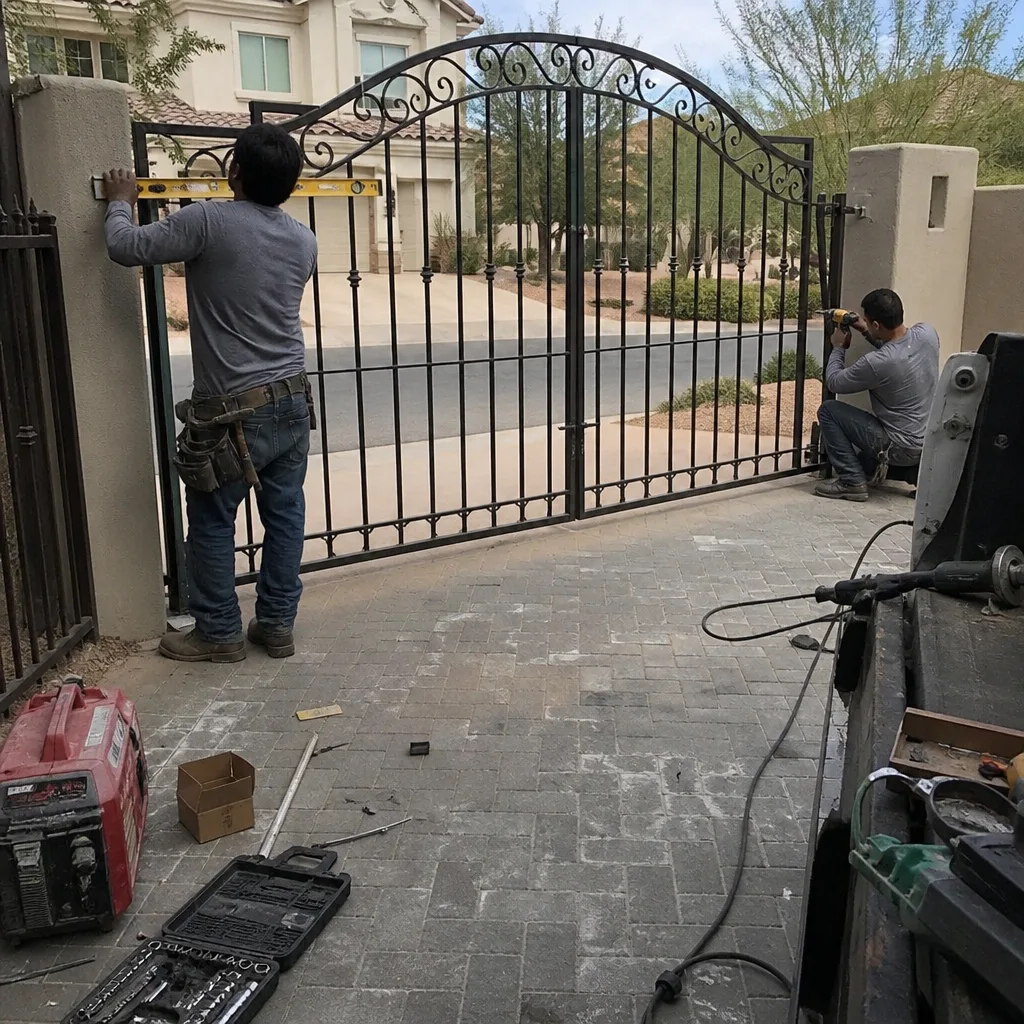
Here’s the part of the DIY conversation that rarely gets its own section, and it’s the most expensive one over time. A structural repair without documentation is a repair that has to be re-diagnosed by the next person who touches it.
Imagine a gate that starts sagging two years after a homeowner re-welded a hinge. The next technician shows up and sees a weld in an unfamiliar position, no record of what the original hinge geometry was, no note of the current limit-switch position on the operator, and no photo of what the gate looked like before the repair. They have to reverse-engineer the problem from scratch. That’s time billed to you, and it often ends in replacing parts that might have been fine.
When a repair is done with documentation, the opposite happens. A written scope names what was found. A photo record shows the original condition and the finished result. A note on the limit-switch reading – say, a switch set 12 degrees past travel that was reset and photographed at its new position – means the next adjustment starts from a known baseline. The gate has a history, not a mystery.
The same logic applies to a failed bolt-on repair you did last season. If you replace a hinge and it doesn’t hold, the conversation with a professional is much easier when you can show what you swapped, when, and what the gate was doing at the time. Observation and photos aren’t just a technician’s habit. They’re the thing that keeps DIY work from becoming a debt the next repair has to pay.
How to Describe What You Observed When You Call
When you do call, the way you describe the problem determines how accurately the visit gets scoped. “My gate is broken” leads to a longer site visit than “the hinge-side post is leaning about an inch and the latch won’t catch on the top half of the swing.” You don’t need to diagnose – just observe, and be specific.
- Say what the gate is doing, not what you think is wrong. “It drags on the driveway when it swings past halfway” is more useful than “the hinge is broken.”
- Note when it started and what changed. “It started after the windstorm last week” or “it happened after I replaced the hinge pin” tells a professional where to look first.
- Name the operator brand if you can. The brand on the housing – Viking, Ghost Controls, DoorKing, Elite, and others we service – tells us which manuals and limit-switch procedures apply.
- Have your photos ready. Before, after, close-up of the weld or hinge, wide shot of the whole gate. Photos let a technician arrive with the right hardware instead of guessing.
- Mention any HOA involvement. If an architectural committee has flagged the repair, say so. It changes the scope and the paperwork.
This is the same documentation discipline we use on every job – and it’s why we photograph the problem before we price the fix, not after. Whether you’re in The Ridges, Red Rock Country Club, or anywhere else across Summerlin, a specific description gets you a tighter, more accurate estimate. Start at Vance Gate Repair Summerlin home if you want to see how a written scope and photo record work in practice.
Common Mistakes to Avoid
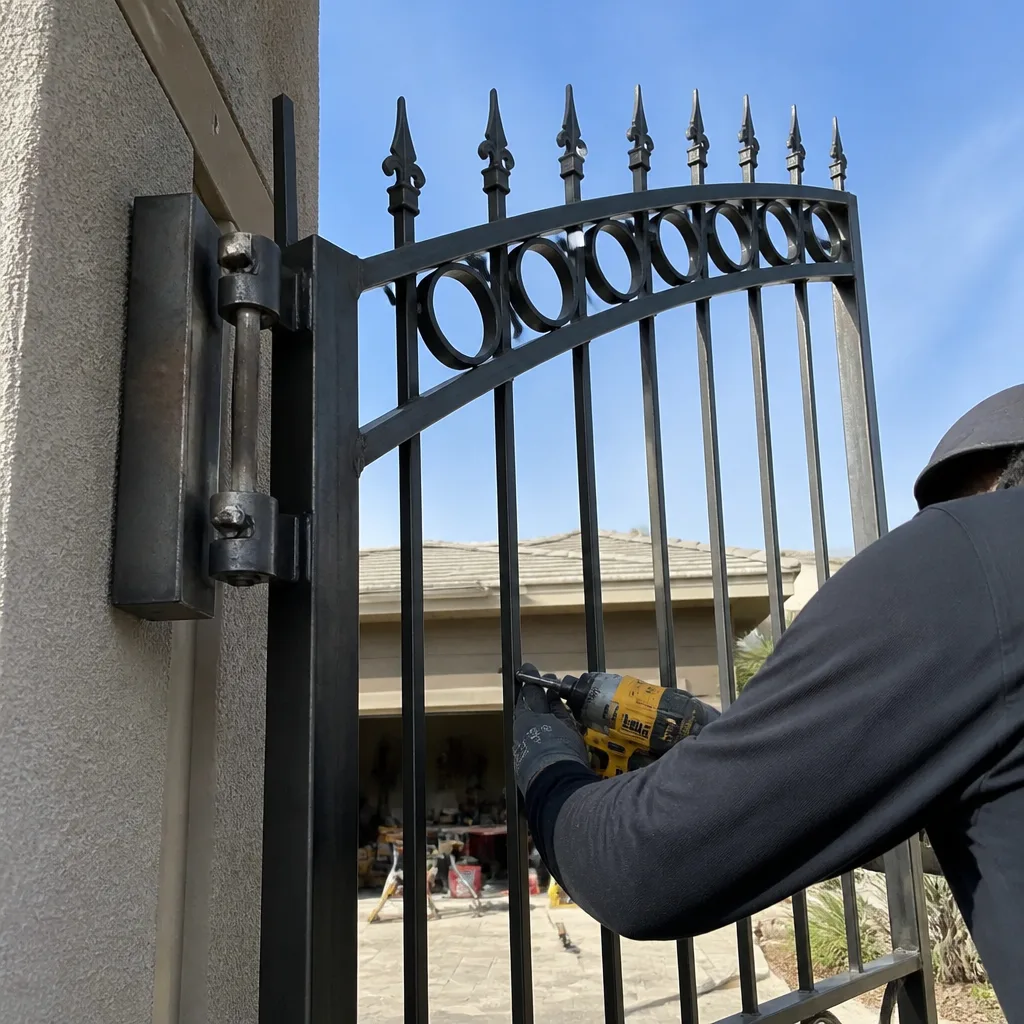
- Welding a hinge back on without checking the post. The hinge is usually the victim, not the cause. If the post has shifted or the footing is cracked, a new weld on a moving post just delays the next failure.
- Using the wrong lubricant on exterior hardware. In Summerlin’s dust and sun, the wrong product collects grit and accelerates wear on hinges and rollers. Gate-rated lubricant only.
- Treating rust at a weld seam as cosmetic. Rust concentrated at a structural joint means moisture has been trapped and the metal underneath may be compromised. That’s a professional assessment, not a sand-and-paint job.
- Over-torquing bolts into aluminum hinge plates. Stripped threads in a hinge plate are a harder repair than the loose bolt you were trying to fix.
- Making structural repairs without documenting them. No photo, no scope, no note on the operator’s limit positions. The next technician pays for that gap, and so do you.
- Adjusting operator limits to fix a mechanical problem. If the gate is dragging or out of alignment, changing the limit-switch positions masks the symptom and stresses the motor. Fix the cause first.
- Assuming an HOA won’t notice or ask for the paperwork later. When a repair comes up for architectural review or an insurance claim, undocumented structural work is the first thing under scrutiny.
See the difference
BeforeAfter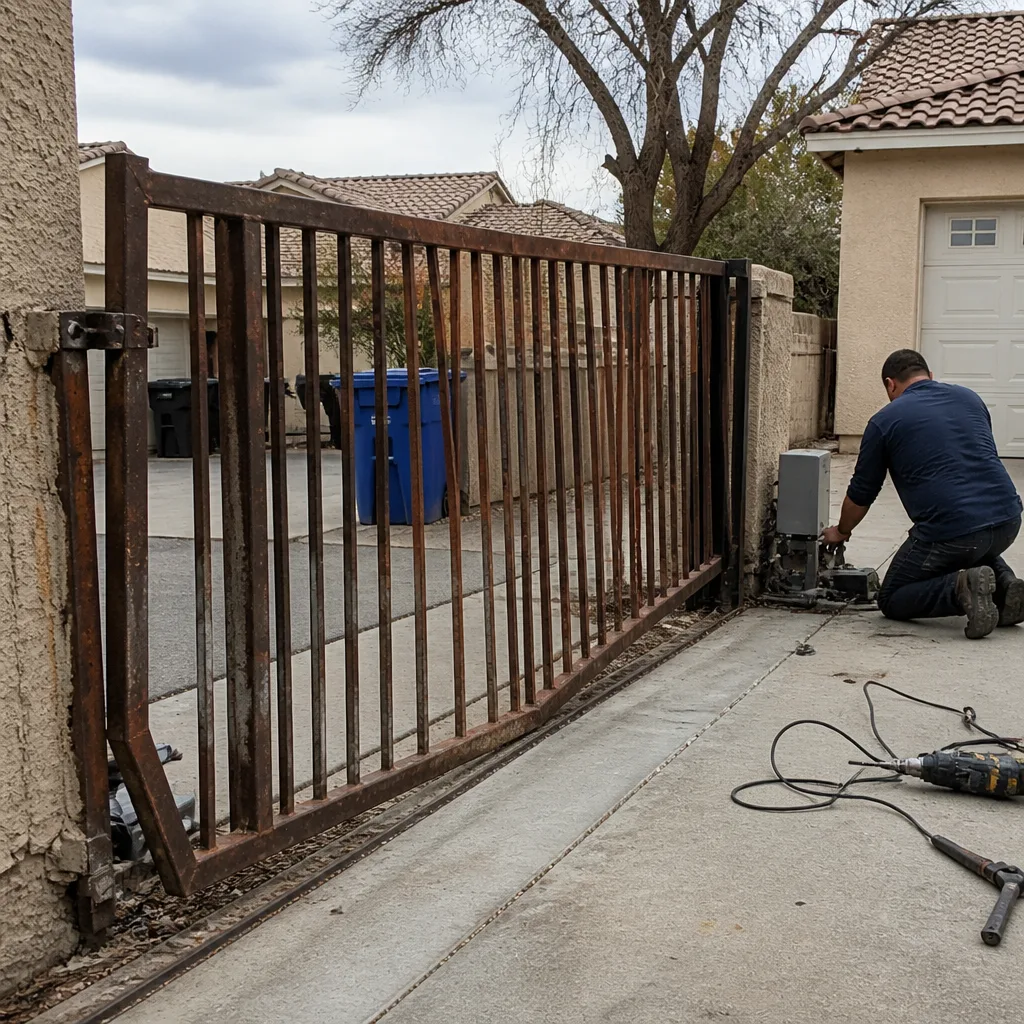 Before
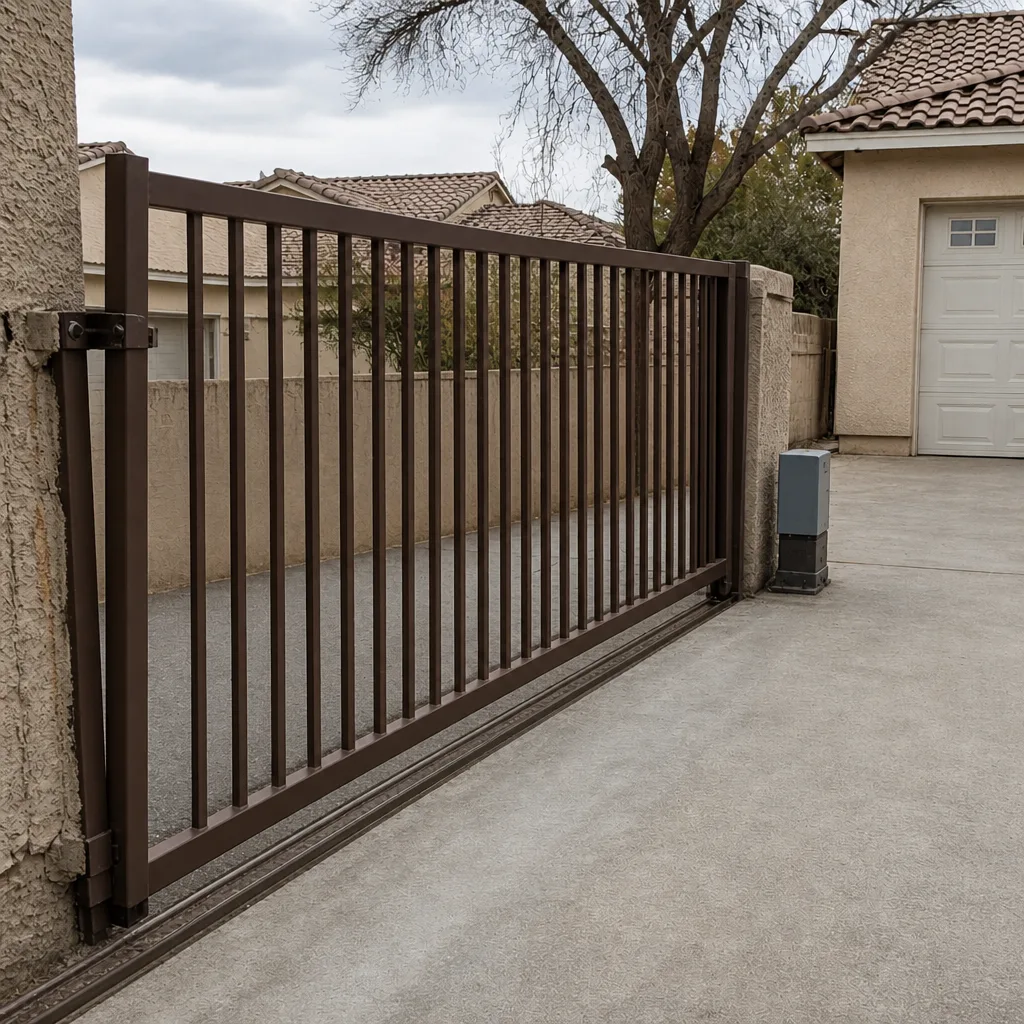 After
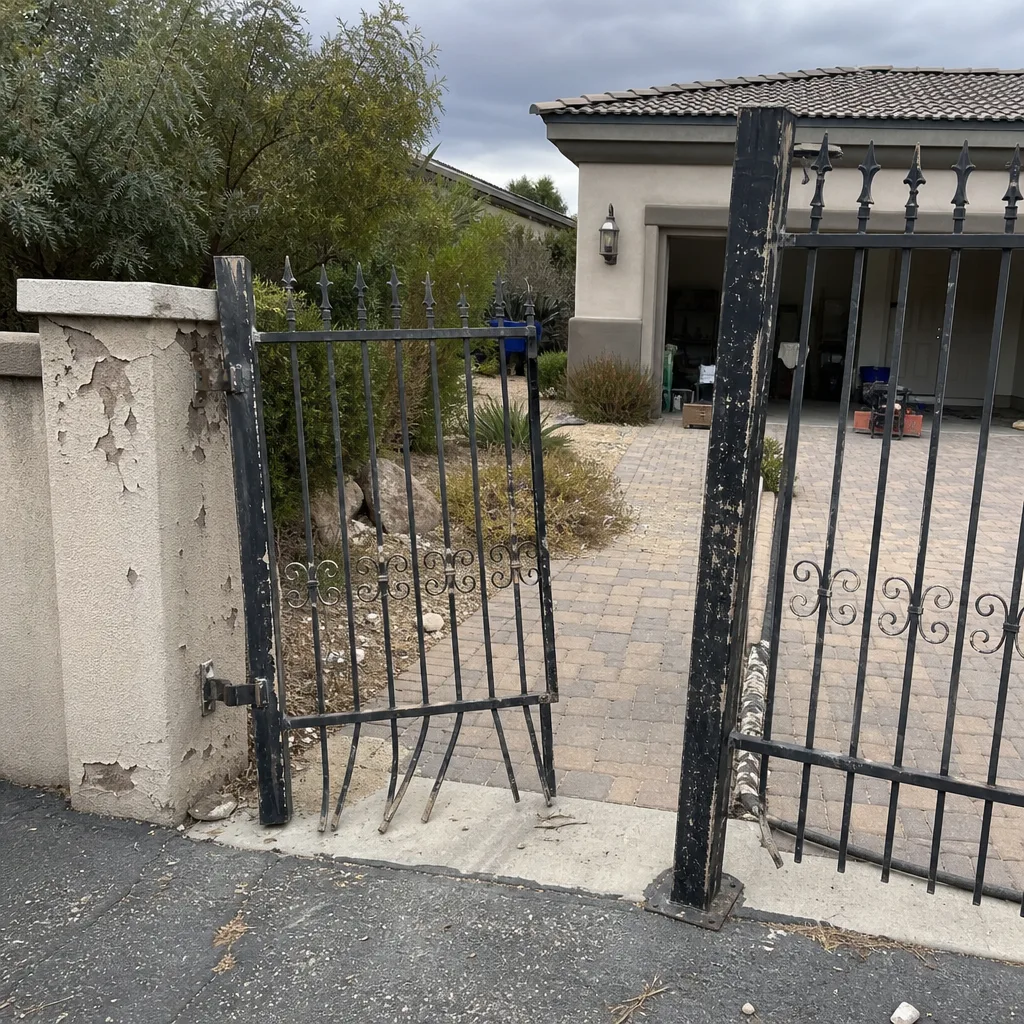 Before
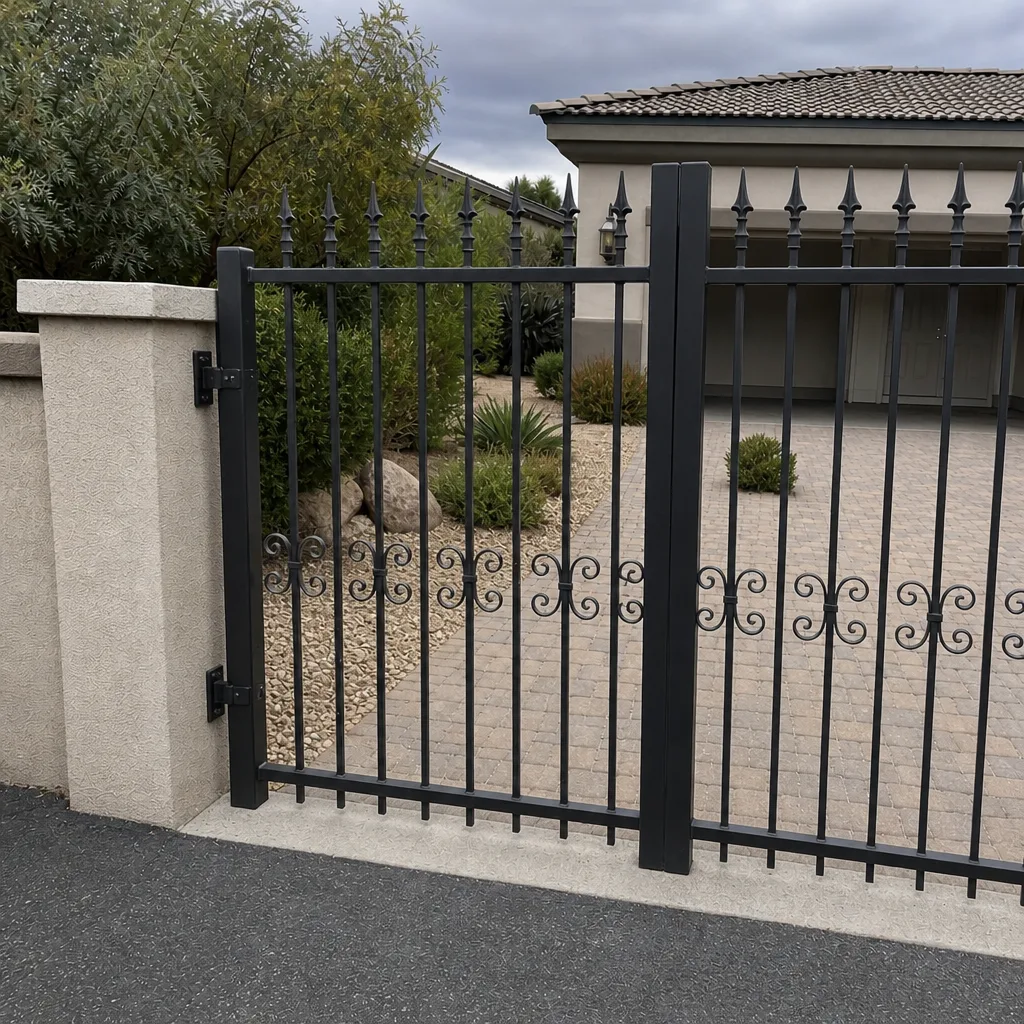 After
When to Call a Professional
Call a professional when the repair involves welding, cutting, post anchors, gate geometry, or anything under stored mechanical load. Call when a repair you made isn’t holding, when you can’t tell whether rust is cosmetic or structural, when the operator and the gate seem to be fighting each other, and when an HOA or insurance claim needs a documented record. Don’t guess on structural work – a gate under load is not a learning project. Vance Gate Repair Summerlin offers free estimates in Summerlin and will give you a written scope and price before any work starts. Call (844) 797-2809 and describe what you observed; we’ll scope the visit accurately from there.
Frequently Asked Questions
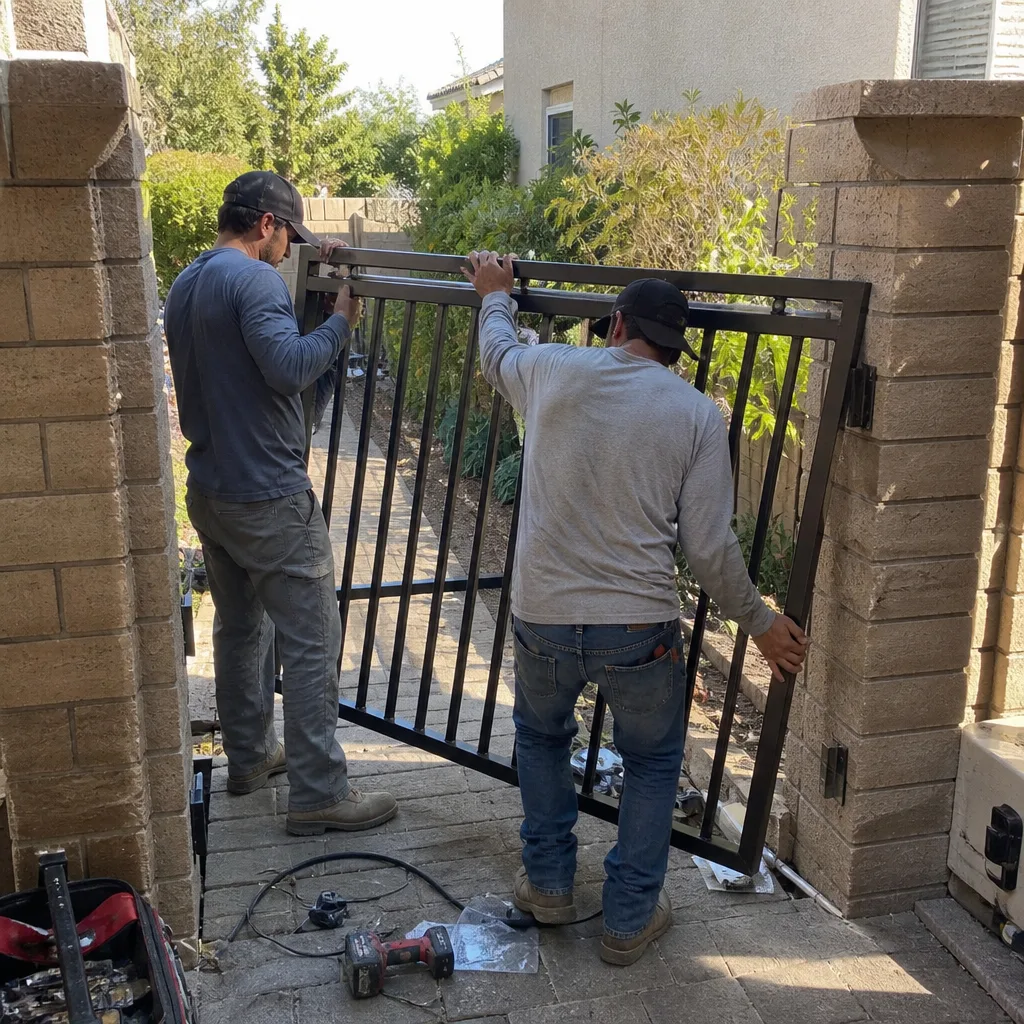
Looking solid isn’t the test. What matters is penetration into the parent metal, the right rod type for the frame material, and whether the post connection can carry the load. A cosmetic bead on thin gate tubing can pass a wiggle test and fail under wind load months later, so structural welding on a gate frame should be done by a trained welder. Call (844) 797-2809 for a free estimate – we’ll tell you honestly what the frame needs.
Light, powdery surface rust away from structural joints is safe to sand, treat with a rust converter, prime, and paint. Rust concentrated at a hinge weld, post base plate, or anywhere structural members meet is a different situation – that’s where the metal underneath may be thinner than it looks. If the rust is pitting or spreading, call (844) 797-2809 for an assessment before the metal thins further.
Not always. Replacing a hinge pin on a sound gate with intact welds and a plumb post is often something a homeowner can do. If the hinge plate is welded to the frame or the post is showing any movement or lean, it’s a structural repair and belongs with a professional. When in doubt, call (844) 797-2809 – a short conversation beats a stripped plate or a leaning post.
Because undocumented repairs have to be re-diagnosed by the next technician, which costs you time and often parts that were fine. A photo record, a written scope, and a note on the operator’s limit-switch positions mean every future repair starts from a known baseline instead of a guess. Our technicians have up to 12 years of experience, and that documentation habit is carried onto every visit. Call (844) 797-2809 if you want a repair that leaves a paper trail.
Get a professional assessment of the repair and put the result in writing. An undocumented structural repair is difficult to defend when a committee or an insurance claim asks questions, and a documented assessment gives you an accurate record going forward. Call (844) 797-2809 and we’ll photograph what’s there, note what needs correcting, and provide a written scope before any work is done.
Describe what the gate is doing, when it started, what changed, and what the operator brand is, and have photos ready. “It drags when it swings past halfway and started after the windstorm” scopes a visit far more accurately than “the hinge is broken.” If you can name the brand on the housing – Viking, DoorKing, Elite, and others – even better. Call (844) 797-2809 with those details and we’ll price the fix in writing before anything starts.
The Bottom Line
The right question isn’t whether you can physically do a gate repair. It’s whether the repair, done without documentation and proper tooling, creates a structural liability that costs more to fix than it saved. Lubrication, tightening, cleaning, and light rust treatment are yours to handle. Welding, post anchors, and anything under load are not. In Summerlin, where HOAs and insurance look closely at gate work, a written scope and a photo record are the thing that keeps a repair on the right side of the problem. If you’re uncertain which tier a job falls into, ask before you pick up a tool.
If a gate repair has moved past maintenance, call Vance Gate Repair Summerlin at (844) 797-2809 for a free estimate. You’ll get a written price before any work begins and a documented record when the technician leaves.
Written by the team at Vance Gate Repair Summerlin.